RKI Initial Validation Autoclave

Meet RKI requirements – free of charge

Use the free ClavioSoft to run an audit check of your practice in just a few minutes – the software automatically generates any missing documentation. This saves you up to 90 % of the work.

ClavioSoft documentation software supports you with RKI documentation and Class B autoclave validation
 

Initial Validation of a Class B Autoclave: IQ, OQ & PQ Step by Step


Validation demonstrates that your Class B autoclave sterilises reproducibly and safely. Under MPBetreibV § 8, reprocessing must be carried out using suitable, validated procedures. The (initial) validation is divided into IQ, OQ and PQ based on DIN EN ISO 17665 and DIN SPEC 58929 as well as KRINKO Annex 4; DIN EN 13060 is the underlying equipment/type-testing standard (process type B).

1Preparation & Planning

· Purpose and scope of the validation to be defined (initial validation after installation).
· Document review: risk assessments, standard operating procedures, training records.
· Standards compliance: verification against DIN EN 13060 and DIN EN ISO 17665.

Sources: KRINKO/BfArM 2012, Section 1.3 (validation of reprocessing procedures) and Section 1.4 (quality assurance: validation IQ/OQ/PQ, periodic performance re-qualification) as well as Annex 4 (small sterilisers, checklist); MPBetreibV § 8; DIN EN 13060 / DIN EN ISO 17665.

2Installation Qualification (IQ)

Verifies that the equipment has been correctly delivered, installed and commissioned:

· Environment: suitable location, room temperature, humidity. · Equipment condition: integrity and completeness of accessories. · Utilities: power supply and, where applicable, water connection. · Initial tests: air leakage test (vacuum/leak test) and empty-chamber test.

3Operational Qualification (OQ)

Ensures that the autoclave operates within the specified parameters:

· Process sequence: testing with a defined worst-case load. · Air removal & steam penetration: using a suitable process challenge device (PCD for hollow instruments, e.g. Helix test). · Fault detection: verification of the fault-detection system per manufacturer instructions, documented in the qualification report.

4Performance Qualification (PQ)

The most important step – demonstrating sterilisation performance with real loads:

· Reference loads: multiple cycles with different, practice-typical loads. · Data recording: measurement of pressure and temperature profiles at the critical points of the test load using an independent, calibrated measurement system (data logger); microbiological testing where physical measurement is not possible. · Drying test: residual moisture on the sterilised goods determined by weight difference before/after the cycle, within the specified limits.

Validation requirement: Under MPBetreibV § 8, reprocessing must be performed using validated procedures. Initial validation is carried out at commissioning; the timing of periodic performance re-qualifications is determined by the operator and validator taking the manufacturer's instructions into account – a fixed annual interval is not prescribed. For Class B benchtop autoclaves, an interval of typically 24 months is common in practice; high cycle counts or larger units may require shorter intervals. In addition, a performance re-qualification is required after significant changes (repair, relocation, process modification).

5Routine Checks & Final Report

Routine checks ensure long-term stability: visual inspection of door seals and loading trays, filter replacement per manufacturer instructions, regular tests. A final report then summarises all results, conditions and recommendations (including the next revalidation date) – a key document to present during a practice inspection. Ongoing batch documentation and full traceability are conveniently managed with the free ClavioSoft.

New equipment, commissioning and initial validation from a single source – with on-site service across Germany, Austria and Switzerland. Find the right Class B autoclave for your needs.
Find the right Class B autoclave Order validation service

Important Additional Points per RKI & Standards

These points are frequently overlooked in practice but are essential for correct and legally compliant implementation:

  • Definition and justification of the worst-case load: Before PQ, the operator together with the validator defines all practice-relevant load configurations and identifies the "most challenging" (worst-case) load with a documented, traceable justification. Only these validated configurations may subsequently be used in routine operation; an equivalence demonstration must be provided for actual loads.Source: KRINKO/BfArM 2012, Annex 4: "Description of all load configurations including the most challenging load(s) (with corresponding justification)"; PQ "Definition and documentation of test loads including equivalence demonstration"
  • Risk classification of medical devices to be reprocessed as a prerequisite: The basis of any validation is the classification of the medical devices to be reprocessed (non-critical / semi-critical / critical per RKI/BfArM). This risk classification determines loads, scope of testing and required process challenge devices; it must be established as an operator document before PQ.Source: KRINKO/BfArM 2012, Annex 4: "Risk classification of medical devices to be sterilised per RKI-BfArM recommendation"; Table 1 (classification)
  • Feed-water quality as an IQ checkpoint: During IQ, the quality of the feed water for the Class B autoclave must be tested and documented against the requirements of DIN EN 13060, Annex C. Unsuitable feed water causes corrosion, deposits and faulty cycles and jeopardises sterilisation performance.Source: KRINKO/BfArM 2012, Annex 4: "Feed-water quality: DIN EN 13060, Annex C"
  • Packaging and sealing process as part of the initial validation: If wrapped sterilised goods are reprocessed, the sterile barrier system and sealing process form part of the validated overall process. For heat sealers, the critical parameters are temperature and contact pressure; the seal width must be at least 6 mm and the minimum distance between the seal and the medical device 3 cm. Packaging must comply with DIN EN 868-2 ff. and DIN EN ISO 11607-1; routine checks include ink/seal-check tests and peel-strength testing.Source: KRINKO/BfArM 2012, Annex 4, "Sterile-goods packaging" and "Heat sealers"; DIN EN ISO 11607-1; DIN EN 868-2
  • Selection of routine process challenge devices (PCD) and chemical indicators as a validation output: A key outcome of validation is the definition of the routine checks required: selection of suitable process challenge devices (PCD), where hollow instruments are sterilised (per DIN EN 13060 Annex A), and selection of chemical indicators and the process assessment system. These specifications are documented in the validation report and govern subsequent batch release.Source: KRINKO/BfArM 2012, Annex 4, "Specifications for routine checks during operation"; DIN EN 13060 Annex A/B
  • Operator training and designation of authorised release personnel (authorisation list): Initial validation and commissioning include documented training of operating personnel in operation and fault response, as well as the creation of an authorisation list of persons permitted to release batches (with proof of qualification and defined release criteria).Source: KRINKO/BfArM 2012, Annex 4: IQ "Training in operation ... and fault response", "Regular instruction of ... personnel", Release "Authorisation list" and "Release criteria"
  • Content and retention of the validation report: In addition to results, the validation report must include recorder printouts/logger protocols, photographic documentation of the tested loads, specifications for routine checks and the due date for the next periodic re-qualification; it must be archived in an audit-proof manner. This tamper-proof filing and retrieval of protocols is handled in just a few clicks with the free ClavioSoft.Source: KRINKO/BfArM 2012, Annex 4: "Validation report with recorder printouts and photographic documentation"; "Determination of the due date for periodic re-qualifications ... validation report"
  • Prior cleaning/disinfection as a validation prerequisite: Sterilisation processes can only be fully validated on the assumption that they are applied to residue-free cleaned medical devices. Initial validation of the autoclave therefore requires a standardised, upstream cleaning and disinfection process.Source: KRINKO/BfArM 2012, Section 1.3: "Sterilisation processes can be fully validated on the assumption of their application to residue-free cleaned medical devices"

Required Equipment, Consumables & Accessories

Checklist for this step – items you should have ready (shopping list):

Equipment

  • Class B autoclave (process type B per DIN EN 13060), installed and ready for operation with complete manufacturer documentation Order in our shop
  • Independent, calibrated measurement/data-logging system for temperature and pressure (traceably calibrated, with valid calibration certificate)
  • Suitable process challenge device (PCD) for hollow instruments (e.g. Helix test) per DIN EN 13060 Annex A Order in our shop
  • Measuring equipment or built-in programme for air-leakage/vacuum test and empty-chamber test
  • Precision balance for determining drying/residual moisture of the sterilised goods (weight difference before/after cycle)
  • Conductivity meter for testing feed-water quality (DIN EN 13060 Annex C)
  • Sealing device (if wrapped goods are reprocessed) for testing seal width and seal strength Order in our shop
  • Digital documentation software for protocol and report recording (optional) Order in our shop

Consumables

  • Practice-typical reference/test loads including the defined worst-case load (own, cleaned instruments)
  • Test packs/indicators for steam-penetration testing in the PCD Order in our shop
  • Chemical indicators of the required classes (process indicator Class 1 and indicators suitable for the test) Order in our shop
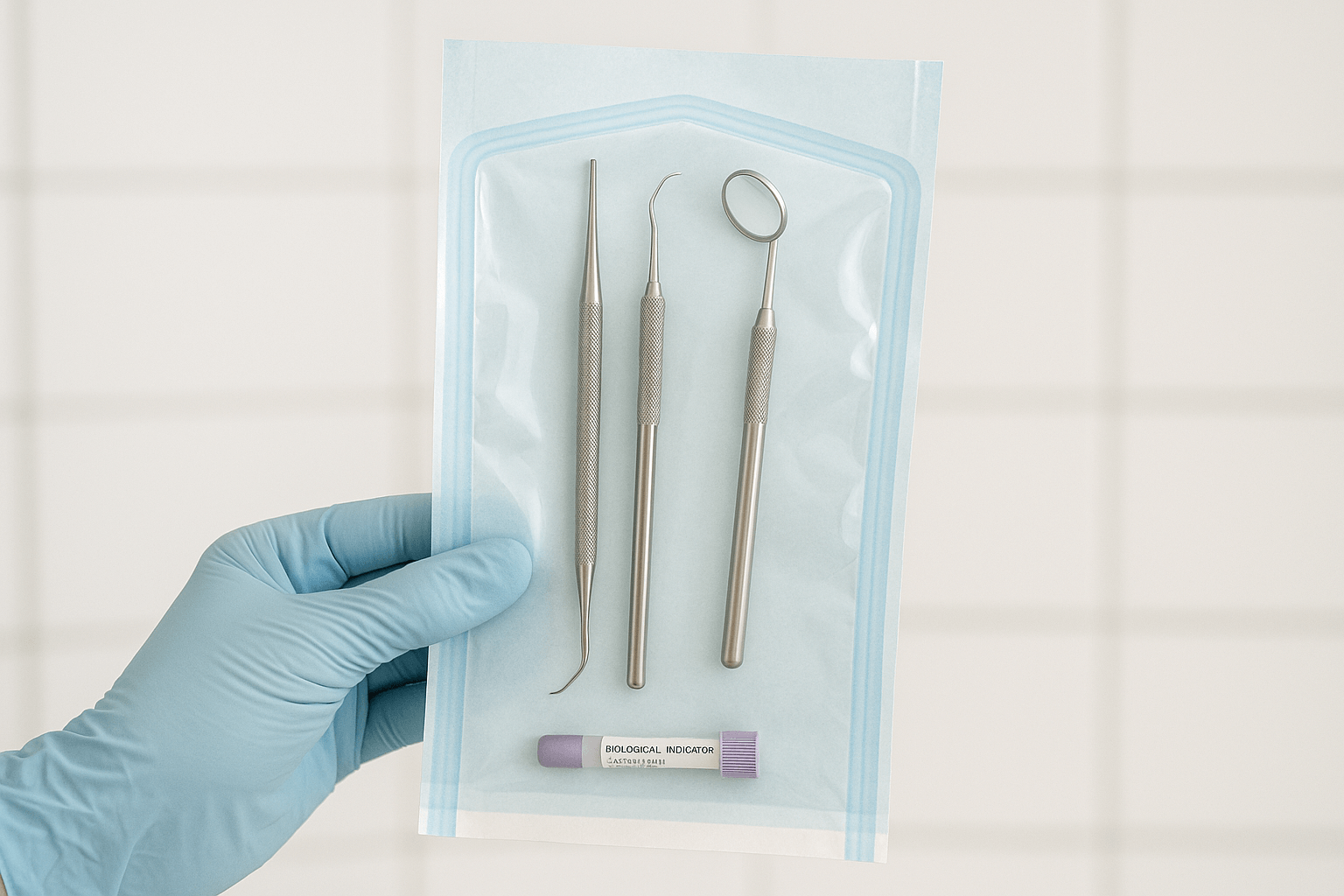
  • Biological indicators where applicable for microbiological testing at points where physical measurement is not possible
  • Sterile barrier systems/packaging materials per DIN EN 868-2 ff. / DIN EN ISO 11607-1 (for wrapped reprocessing) Order in our shop
  • Seal-check/ink-test strips for seal-seam inspection (for wrapped reprocessing) Order in our shop
  • Treated feed water of suitable quality (e.g. demineralised) for test cycles Order in our shop
  • Replacement seal and cleaning agent per manufacturer instructions (for IQ visual inspection)

Accessories

  • Loading trays/racks and holders matching the unit Order in our shop
  • Sensor positioning aids for placing loggers at the critical points of the load
  • Calibration certificates/traceability records for the measuring instruments used
  • Equipment recorder/printer or interface for protocol output (recorder printouts) Order in our shop
  • Camera for the required photographic documentation of load configurations
  • Manufacturer documentation: equipment, operating and maintenance instructions, type-test/CE certificate
  • Documentation templates: risk classification, load lists, IQ/OQ/PQ protocols, installation/handover protocol, authorisation/release list, training record, validation report template Create digitally with ClavioSoft

Templates & References

  1. KRINKO/BfArM 2012, Bundesgesundheitsbl. 55:1244–1310 – Section 1.3; Annex 4 (small sterilisers).
  2. DIN EN 13060 (steam small sterilisers); DIN EN ISO 17665 (steam sterilisation, validation).
  3. MPBetreibV § 8 (validated procedures).

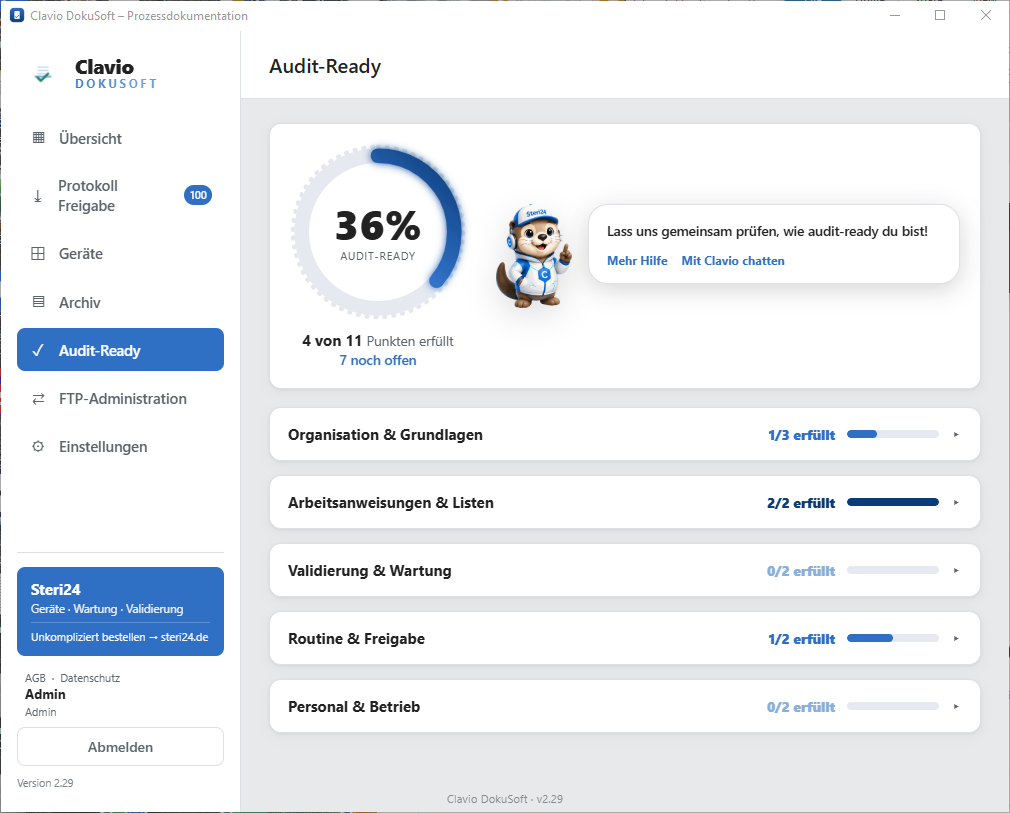
How audit-ready is your practice?

Find out in just a few minutes how well you are prepared for the next inspection — category by category, with clear progress tracking and specific open items. Completely free with ClavioSoft.

ClavioSoft Audit-Ready Check: progress display and categories
Download ClavioSoft for free
Free forever For autoclaves of all manufacturers RKI-compliant

1 to 1 (from a total of 1)

Frequently Asked Questions

RKI Initial Validation Autoclave – key questions answered clearly.

What does the validation of a Class B autoclave mean?
Validation is a documented examination that demonstrates your Class B autoclave sterilises reproducibly and safely. It comprises IQ, OQ and PQ in accordance with DIN EN ISO 17665 and DIN SPEC 58929. Under MPBetreibV Section 8, reprocessing must be carried out using validated procedures.
What do IQ, OQ and PQ mean in autoclave validation?
IQ (Installation Qualification) verifies delivery, installation and commissioning. OQ (Operational Qualification) demonstrates that the equipment operates within the specified parameters. PQ (Performance Qualification) proves sterilisation performance with practice-typical loads - the most important step.
Is autoclave validation a legal requirement?
Yes. Anyone who reprocesses critical instruments that come into contact with blood on humans must use validated procedures under MPBetreibV Section 8. This applies to medical practices, clinics, podiatry, beauty salons as well as tattoo and piercing studios. Without critical instruments, validation is generally not mandatory.
When must the initial validation be carried out after purchase?
Initial validation takes place at commissioning and should be performed promptly after installation during an on-site appointment. The unit is ready for use immediately after delivery; validation can also be arranged shortly afterwards.
How does the initial validation of an autoclave work?
A qualified validator tests on site with calibrated sensors at the point of use: including vacuum/leak test, empty-chamber test and several sterilisation runs with your instruments as the load. You then receive a validation report.
What is checked during Installation Qualification (IQ)?
IQ verifies correct delivery, installation and commissioning: suitable location, room temperature and humidity, integrity and completeness, utilities (power, water connection where applicable) and initial tests such as air-leakage and empty-chamber tests.
What is checked during Operational Qualification (OQ)?
OQ ensures that the autoclave operates within the specified parameters. The process sequence with the worst-case load, air removal and steam penetration using a suitable process challenge device (PCD/Helix test for hollow instruments) and the fault-detection system per manufacturer instructions are all tested.
What is checked during Performance Qualification (PQ)?
PQ demonstrates sterilisation performance with practice-typical loads. Pressure and temperature profiles are recorded at critical points using an independent, calibrated measurement system (data logger); additionally, a drying test for residual moisture and, where applicable, microbiological tests are carried out.
How often must a Class B autoclave be revalidated?
A fixed annual interval is not prescribed; the operator and validator determine the timing taking the manufacturer's instructions into account. For Class B benchtop autoclaves, 24 months is typically standard in practice; high cycle counts or larger units may require shorter intervals.
Which standards apply to autoclave validation?
The key standards are DIN EN ISO 17665 and DIN SPEC 58929 for the validation of steam sterilisation processes as well as KRINKO/BfArM 2012 (Annex 4). DIN EN 13060 is the equipment/type-testing standard for Class B processes. The legal basis for the requirement is MPBetreibV Section 8.
Can I carry out the autoclave validation myself?
No. Validation must be performed by a qualified validator with calibrated measuring equipment; carrying it out yourself is practically not feasible. Installation and commissioning, however, may be performed by yourself per the manual. You can book the validation service on site.
Does the initial validation always have to be performed on site?
Yes. Validation must take place at the point of use with your instruments as the load, since it tests the actual conditions on site (DIN SPEC 58929). Sending the unit to a facility is not possible for this purpose - a shipped unit can be serviced but not validated.
What is the worst-case load in validation?
Before PQ, the operator together with the validator defines all practice-relevant load configurations and identifies the most challenging (worst-case) load with documented justification. Only these validated configurations may be used in routine operation; an equivalence demonstration must be provided for actual loads.
What is an equivalence demonstration for autoclave loads?
An equivalence demonstration proves that an actual practice load is equivalent to the validated test loads and achieves the same sterilisation safety. It is required under KRINKO/BfArM 2012, Annex 4, for configurations that were not directly validated but are equivalent.
Why is instrument risk classification a prerequisite for validation?
The basis of any validation is the classification of medical devices into non-critical, semi-critical and critical per RKI/BfArM. This determines loads, scope of testing and process challenge devices. It must be established as an operator document before PQ.
What water quality is tested during IQ?
During IQ, feed-water quality must be tested and documented against the requirements of DIN EN 13060, Annex C. Unsuitable feed water leads to corrosion, deposits and faulty cycles. A suitable water treatment system ensures consistent values.
What is a PCD in autoclave validation?
A PCD (Process Challenge Device) is a test body that simulates a load that is difficult to sterilise, such as narrow hollow instruments. For critical-B instruments, a hollow-body PCD like the Helix test is used to verify air removal and steam penetration.
What is the Helix test and what is it used for?
The Helix test is a hollow-body process challenge device (PCD) that uses an indicator to assess steam penetration in long, narrow lumens. It is part of the air-removal testing for Class B processes and is used during OQ/PQ as well as in routine checks.
What is the purpose of the vacuum test during validation?
The vacuum or leak test checks the chamber's integrity and whether air leakage is within the specified limits. An intact vacuum function is a prerequisite for complete air removal and steam penetration in the Class B process; it is part of the IQ initial tests.
What is an empty-chamber test on an autoclave?
During the empty-chamber test, the temperature and pressure profile in the empty chamber is recorded using calibrated sensors. It demonstrates that the steriliser achieves a uniform, standards-compliant process profile across the chamber volume and is part of IQ/OQ.
How is residual moisture of sterilised goods tested during validation?
The drying test determines residual moisture by the weight difference of the test load before and after the cycle. The values must be within the normative limits, as damp sterilised goods compromise the sterile barrier and void sterility.
How long is a validation report valid and how long must it be retained?
The report is valid until the next scheduled performance re-qualification, the date of which it specifies - typically 24 months in practice. Validation and batch records must be retained as reprocessing documentation and presented during inspections; the retention period is determined by operator requirements.
Do I need to revalidate after an autoclave repair?
Yes, a performance re-qualification is required after a major repair, as the process behaviour may have changed. Only after successful revalidation is reproducible sterilisation safety demonstrated again.
Do I need to revalidate after relocating the autoclave?
Yes. Relocation counts as a significant change requiring revalidation, since utilities, environment and water quality may differ. IQ and a performance re-qualification at the new installation site must be carried out.
How much does the initial validation of an autoclave cost?
Costs depend on the location. In Germany and Austria, initial validation is approximately 1,199 euros including travel and report; costs are higher in Switzerland. We are happy to provide a specific quotation on request.
Why is the initial validation so expensive?
Initial validation requires the on-site visit of a qualified validator, sophisticated calibrated measuring equipment and several documented test runs on site with your instruments. This legally required examination and report determine the price.
Is the initial validation included in the purchase price of the autoclave?
No, the initial validation is not automatically included in the unit price, as it must be performed on site. You can order it together with the autoclave or separately at any time via the validation service.
How is the measuring equipment calibrated during validation?
The validator uses traceably calibrated sensors and loggers; their accuracy is verified by valid calibration certificates. Only calibrated measuring equipment provides the required pressure and temperature data, which is why self-measurement without such certificates is not permissible.
Is validation mandatory for a podiatry or foot-care practice?
As soon as you reprocess instruments that come into contact with blood, validation is mandatory in podiatry and foot care as well. In pure foot care without critical instruments, it is often not required; it can be arranged at any time.
Does an autoclave in a tattoo or piercing studio need to be validated?
Yes. If instruments that come into contact with blood are reprocessed, the validation requirement under MPBetreibV Section 8 also applies to tattoo and piercing studios. Initial validation is carried out on site with your instruments as the load.
Does an autoclave in a veterinary practice need to be validated?
In a purely veterinary context, validation is not a legal requirement, as the obligation only applies to the reprocessing of instruments used on humans. Voluntary validation for quality assurance purposes can be arranged at any time.
What is the difference between Class B, S and N autoclaves?
Class B per DIN EN 13060 uses fractionated vacuum and is suitable for all instruments including hollow items and wrapped goods. For the reprocessing of critical instruments used on humans, the Class B process is essential; only it provides the basis for a standards-compliant validation.
Who is authorised to carry out an autoclave validation?
Validation must be performed by a qualified validator with calibrated measuring equipment; carrying it out yourself is practically not feasible. Our validation service handles the entire process on site; alternatively, another suitable provider can be engaged.
What is included in a validation report?
The final validation report summarises all results from IQ, OQ and PQ, the defined load configurations, any conditions and recommendations as well as the next revalidation date. It serves as proof of reproducible sterilisation performance.
How long does an initial validation take on site?
Duration depends on the unit, load configurations and scope of testing and includes several documented test runs. We coordinate the specific time required individually. Plan for half a day to a full working day for the on-site appointment.
How quickly can I get an appointment for initial validation?
The waiting time is currently usually one to two weeks, often faster in larger cities. We arrange the appointment individually. In the meantime, you can already use the delivered unit.
Which documents do I need before validation?
Before validation, risk assessments, standard operating procedures and training records must be reviewed, and the risk classification of the medical devices to be reprocessed must be available as an operator document. This document review is part of the preparation and planning phase.
What is the difference between maintenance and validation of an autoclave?
Maintenance is the technical upkeep of the unit; validation is the documented examination of the entire sterilisation process. Both are separate services but can be carried out more cost-effectively as a package in a single appointment, since travel costs are incurred only once.
What are critical and semi-critical instruments in reprocessing?
Per RKI/BfArM, semi-critical instruments are those with mucous-membrane contact; critical instruments penetrate tissue or come into contact with blood. Critical instruments require steam sterilisation in a validated Class B process; the classification determines loads and scope of testing.
What are routine checks after validation?
Routine checks ensure long-term stability between validations: visual inspection of door seals and loading trays, filter replacement per manufacturer instructions and regular tests such as vacuum and steam-penetration tests. They complement periodic performance re-qualification but do not replace it.
What happens if the validation fails?
If the validation is not passed, the causes are identified - for example insufficient drying, leakage or unsuitable feed water. After rectification, a re-test is carried out. Until successful demonstration, the process may not be considered validated for critical reprocessing.
Why is a Class B autoclave alone not sufficient for safe sterilisation?
Class B per DIN EN 13060 is the technical prerequisite but does not on its own guarantee safety at the point of use. Only validation (IQ/OQ/PQ) demonstrates with your loads and conditions on site that the process sterilises reproducibly.
Which measurement system is used during PQ?
During PQ, pressure and temperature are recorded at the critical points of the test load using an independent, calibrated measurement system (data logger). Where physical measurement is not possible, additional microbiological testing is carried out.
What is a steam-penetration test and when do I perform it?
The steam-penetration test, for example using a hollow-body PCD such as the Helix test, checks air removal and steam penetration daily before the first loaded cycle. It is part of routine checks and complements periodic performance re-qualification but does not replace it.
Do you offer installation and initial validation as a complete package?
Yes. New equipment, commissioning and initial validation are available from a single source - with on-site service across Germany, Austria and Switzerland and free-of-charge travel. Operator training during commissioning can be integrated on request.
Is operator training part of the initial validation?
Operator training is integrated during commissioning and initial validation on site. On request, we also offer additional training for your staff on proper sterilisation and documentation, as trained users are a prerequisite for safe reprocessing.
Are sealing devices also validatable?
Yes, validatable sealing devices can be tested in accordance with DIN EN ISO 11607, as packaging is also part of the validated reprocessing chain. Our sealing devices are validatable in line with the applicable national and state-level requirements.
How do I document ongoing batch release after validation?
After validation, batches must be documented without gaps and released with full traceability. Ongoing batch documentation is conveniently managed with the free ClavioSoft, which largely automates record-keeping and evidence management.
What does OQ check regarding autoclave fault detection?
During OQ, it is verified whether the fault-detection system reliably identifies deviations such as insufficient pressure, temperature or time and flags the cycle as failed. Testing is carried out per manufacturer instructions and documented in the qualification report.
What requirements must the installation room meet for IQ?
For IQ, a suitable location, appropriate room temperature and humidity as well as power supply and, where applicable, a water connection must be available. Verified feed-water quality per DIN EN 13060, Annex C, is also among the prerequisites.