Frequently Asked Questions
Eye Clinic – key questions answered clearly.
Which autoclave is suitable for an eye clinic?
For ophthalmic surgery facilities we recommend a Klasse B autoclave with a 23-45 L chamber volume, since several surgical sets and containers need to be reprocessed per cycle here. Both product lines (Pro and Premium) are validatable; you can determine which size and configuration suits your instrument throughput in just a few minutes using the autoclave configurator.
Why do I need a Klasse B autoclave in ophthalmology?
Microsurgical eye instruments are often hollow, fine and reprocessed wrapped. Only a Klasse B autoclave with a fractionated vacuum process reliably sterilizes wrapped, hollow and porous instruments. Class N is not permitted for the reprocessing of critical instruments used on humans.
What does Klasse B mean for an autoclave?
Klasse B denotes fully featured steam sterilizers with a fractionated vacuum process that also sterilize wrapped, hollow and porous instruments. For instrument reprocessing in medical facilities, a Klasse B device is mandatory in Germany.
Which chamber size makes sense for full surgery days in eye surgery?
For high instrument throughput on surgery days, 23 L or 45 L make sense, as several containers and trays fit per cycle here. With very high volumes, a second device can increase operational reliability. We are happy to clarify the right mix in a consultation.
Do my existing surgical cassettes fit in the 23 L autoclave?
That depends on the exact dimensions of your cassettes, trays and containers. Give us your container and basket dimensions and we will tell you the suitable device and, if needed, put together a quote. This way we make sure that your existing cassettes fit.
Do you have trays and containers for micro-instruments?
Yes, we offer matching trays, containers and trays for fine micro-instruments such as those used in eye surgery. We are happy to advise you on which accessories suit your instruments and your autoclave; you can also find an overview via the configurator.
Can the autoclave sterilize hollow and microsurgical instruments?
Yes, our Klasse B autoclaves are suitable for hollow bodies and fine, critical A/B instruments. The only exceptions are instruments that the manufacturer explicitly marks as not autoclavable. Please observe the manufacturer's specifications for your micro-instruments.
What risk classification do ophthalmic surgery instruments have?
Instruments that penetrate sterile tissue or the vascular system are considered critical and must be sterilized wrapped; complex or hard-to-clean instruments are classified as critical B. The exact classification is made through your risk assessment. When in doubt, our expert advisory service can help you.
Why is intermediate rinsing so important for ophthalmic surgery instruments?
According to KRINKO/BfArM, standardized, proper intermediate rinsing with suitable water is of the utmost importance when reprocessing ophthalmic instruments. Residues of alkaline cleaning agents must be reliably removed to prevent burns to the patient's eye. The removal of alkalinity must be demonstrated as part of the process validation.
Do you recommend machine pre-cleaning in a washer-disinfector for eye surgery?
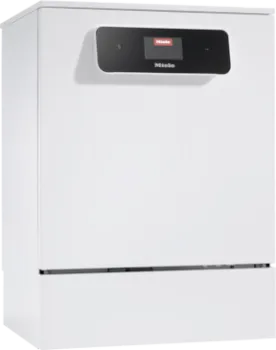
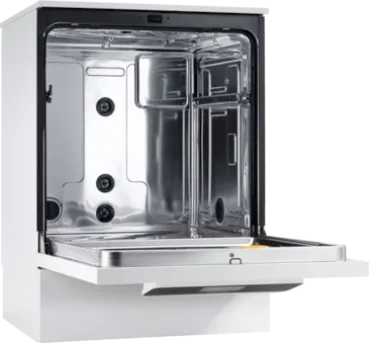
Yes, for reproducible results we recommend machine cleaning and disinfection in a washer-disinfector (WD). For ophthalmic instruments, the success of the rinsing should be ensured by selecting the appropriate program. You get the autoclave, washer-disinfector and validation from us all from a single source.
Do you offer complete reprocessing from a single source?
Yes. You get the autoclave, washer-disinfector for machine pre-cleaning, sealing device, water treatment and the validation completely from a single source – installed, instructed and serviced. This way you avoid interfaces between multiple suppliers.
What is a complete solution for the eye clinic?
A complete solution bundles the autoclave, washer-disinfector, sealing device and water treatment with installation, instruction, initial validation and maintenance. This covers your entire reprocessing workflow with full process reliability. We put together the right scope individually for your facility.
What does validating an autoclave mean?
Validation is a formal test that demonstrates that your autoclave and the entire reprocessing process meet the applicable standards and sterilize reliably. It is carried out on site with your instruments as the load.
Is validation mandatory in eye surgery?
Anyone reprocessing critical instruments that come into contact with tissue or blood used on humans – as is customary in eye surgery – is required to validate; the basis is, among others, the MPBetreibV. Steri24 handles the entire process on site.
How does validation work?
During validation, the autoclave and reprocessing process are assessed on site: using sensors, a vacuum test, an empty-chamber profile and several sterilization runs with your instruments are performed, among other things. You then receive a validation report.
How often does the autoclave have to be validated?
Validation is generally due every 2 years; with trouble-free operation of a Klasse B autoclave, this interval can be fully utilized. Larger devices (e.g. 45 L) or a high number of cycles may require earlier revalidation.
What is an initial validation and when does it take place?
During the initial validation, an authorized validator checks on site with measuring sensors whether your autoclave meets all requirements at the place of use. It should take place shortly after commissioning in a separate appointment; you can already use the device until then.
Does validation always have to take place on site?
Yes, validation must be carried out on site with your instruments as the load, because it tests the actual conditions at the place of use. Shipping to the factory is not possible for this. We come to you for initial validation and revalidation.
Who carries out the validation – can I do it myself?
Validation must be carried out by an authorized validator with special measuring technology and is practically not feasible to do yourself. Steri24 handles the entire process on site.
Can you also validate an existing old device?
We can validate many third-party devices, provided the prescribed maintenance has previously been carried out by the manufacturer or an authorized partner. Send us the model and manufacturer, then we will examine the individual case and prepare a quote.
Do I meet the RKI requirements with Steri24?
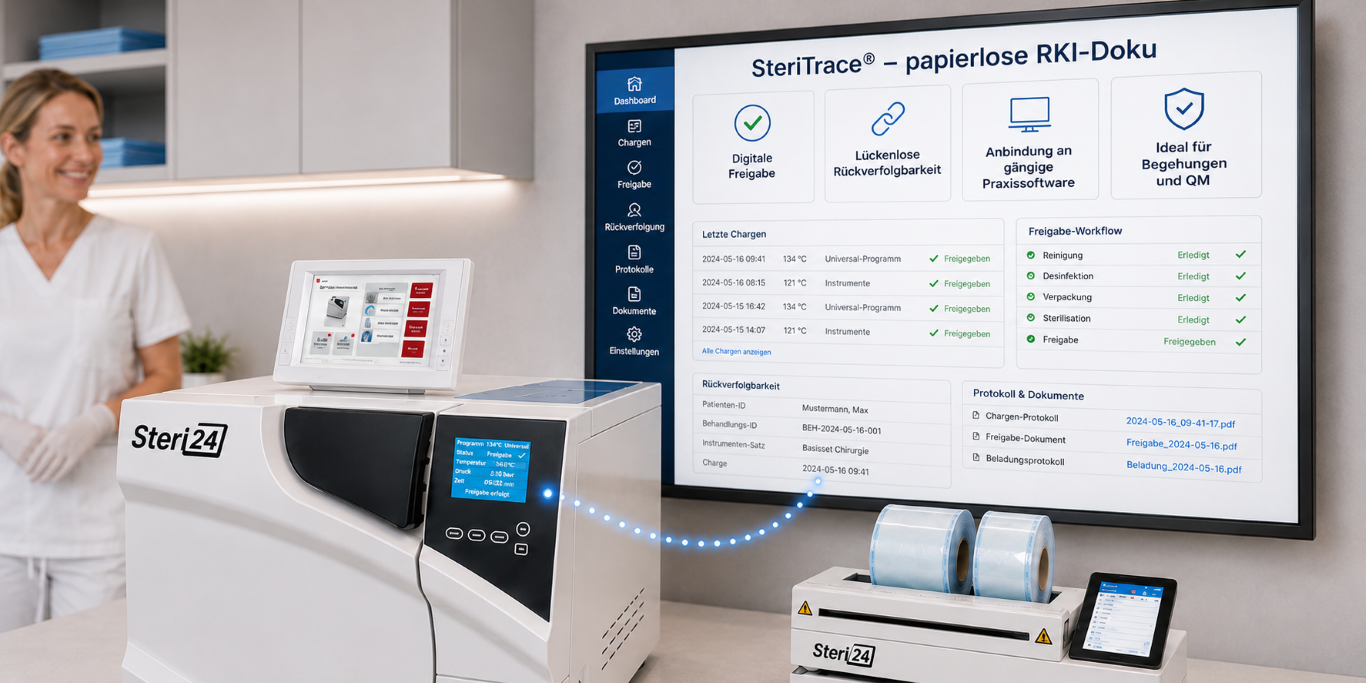
Yes. All devices are Klasse B according to EN 13060. With SteriTrace® you document every batch audit-proof and paperless; we handle validation and maintenance on site. This way you meet the requirements with full process reliability.
How is batch release documented in the clinic?
Batch release can be done paperless on the touchscreen, via your practice software (Premium) or classically by form (Pro). Among other things, the date, batch, process parameters and release are documented. This keeps every batch traceable.
What is SteriTrace® and why do I need it?
SteriTrace® is our assistant for paperless, RKI-compliant batch documentation. It enables digital release, complete traceability and connection to common practice software – ideal for inspections and quality management.
Does the autoclave create the sterilization records itself?
Yes, our Klasse B autoclaves log every cycle digitally. Documentation can be done via USB/SD, printout or automatic transfer to your practice PC – tailored to your workflow.
Can the documentation be connected to our practice or clinic software?
Yes, the Premium devices support LAN/WLAN and the connection to common practice software for digital batch release. We are happy to clarify individually with you which connection is possible in your facility.
What is the difference between Pro and Premium?
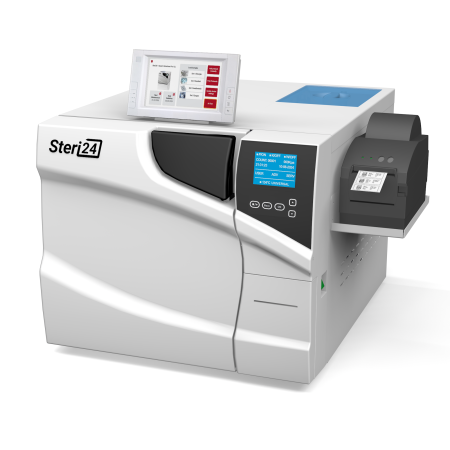
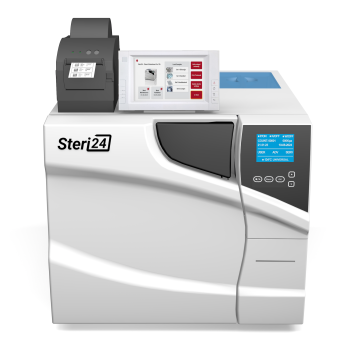
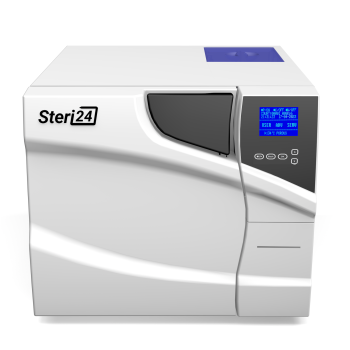
Pro is robust, simple and great value, with documentation via USB and thermal printer as well as integrated water tanks. Premium additionally offers digital batch release on the touchscreen, LAN/WLAN, practice software connection and the SteriTrace® assistant. Both are Klasse B and validatable.
Which model do you recommend for a fully digital, networked clinic?
For the fully digital, networked facility we recommend the Premium line with digital batch release, network connectivity and paperless documentation via SteriTrace®. You can determine which size (23 or 45 L) suits your throughput via the configurator.
Do eye instruments have to be sterilized wrapped?
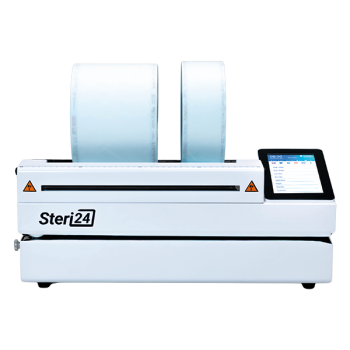
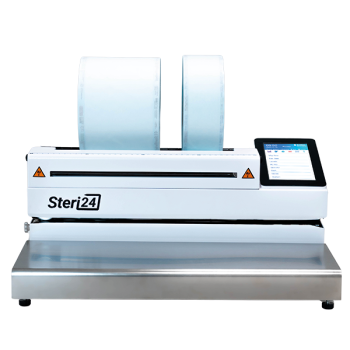
Critical instruments that penetrate sterile tissue must be sterilized wrapped and stored sterile to maintain sterility until use. For wrapping, we offer the right solution with the CertoSeal sealing device.
Do you offer a sealing device for packaging the instruments?
Yes, with the CertoSeal sealing device you package critical instruments in compliance with standards. It is designed for everyday clinical use and is validatable. We are happy to advise on which model suits your volume.
Which documentation and validation obligations apply to the sealing device?
The sealing process is also subject to documentation and is validatable; a regular seal seam test (seal check) is part of process control. Our sealing devices are validatable according to the applicable requirements. We clarify the details as part of your reprocessing documentation.
How must wrapped sterile goods be stored?
Wrapped sterile goods are stored dry, dust-protected and properly so that sterility is maintained until the storage expiry date. The film should not be damaged. Details depend on your packaging material and your in-house policy.
Do I need water treatment for the autoclave?
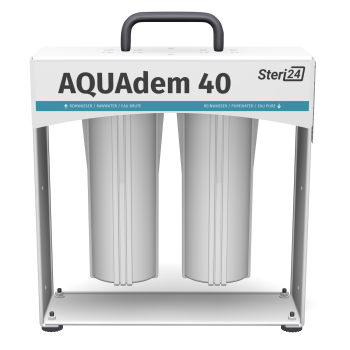
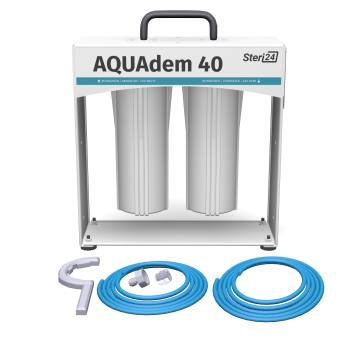
A Klasse B autoclave requires distilled or demineralized water of suitable quality. With our water treatment (AQUAdem) you automatically ensure the necessary water quality and protect the device from deposits. Suitable water is particularly important for the intermediate rinsing of ophthalmic surgery instruments.
What happens to my old autoclave when I switch?
We advise you on switching, take back your old device and dispose of it properly – regardless of manufacturer. This way you can make the switch without any effort.
I don't know Steri24 – why should I switch?
Steri24 sells directly – without the detour via depots or middlemen – and handles the service itself. This way you get a dense on-site service network like that of established expensive suppliers, but at fairer prices. The autoclave is built by a manufacturer with over 60 years of experience since 1957.
How quickly is delivery and installation done?
Devices are usually available at short notice. On request, we handle delivery, installation and commissioning in accordance with the statutory requirements as well as the initial validation on site. We arrange the exact appointment individually with you.
Do you handle setup and commissioning in the clinic?
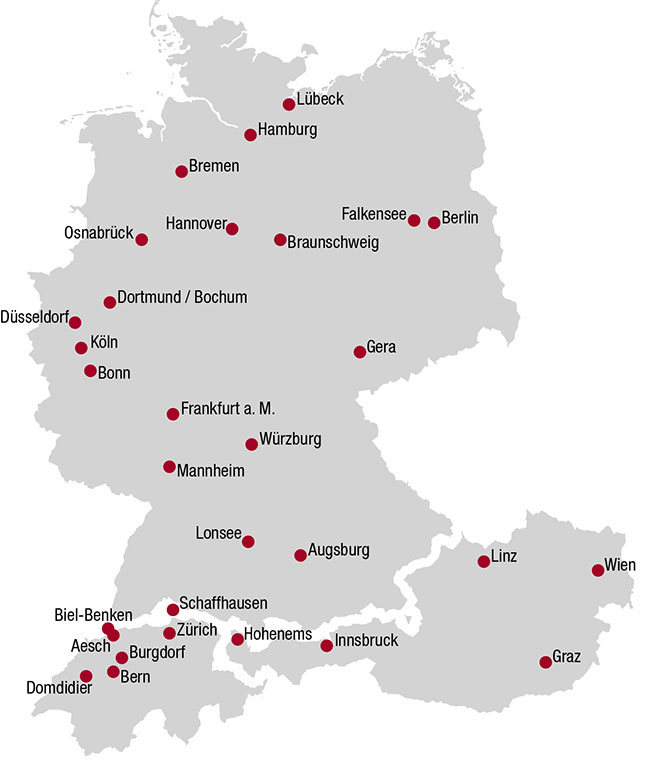
Yes, we carry out setup, installation, instruction and initial validation on site on request. Our technicians and partners operate in Germany, Austria and Switzerland, and travel is free of charge.
How is the service network set up?
We are present on site with 39 locations and over 150 partners across the DACH region – directly from the manufacturer, without middlemen. When it matters, we are quickly with you.
Is there an emergency service on weekends?
Yes, we offer a 24h emergency service – including weekends. Especially for surgical operations, a fast response to device problems is crucial so that reprocessing does not come to a standstill.
Is there a loaner device during maintenance or in case of a defect?
Depending on the situation and device, we can offer an interim solution so that your surgical operation is not interrupted. Talk to us about it; in an emergency you can reach our 24h service.
Do you offer maintenance and warranty options?
As standard, you receive a 2-year warranty, extendable to up to 3 years with a service contract. We offer maintenance and validation at a fixed price including travel. We are happy to tell you the exact terms.
What does a service contract include?
A service contract includes regular maintenance, often combinable with revalidation in one appointment, and can extend the warranty. The combination of maintenance and revalidation on one day is cheaper than separate appointments.
At what interval must the autoclave be serviced?
Maintenance and revalidation are generally due every 2 years, possibly earlier with a high number of cycles. Even with low use, maintenance is required after the interval has elapsed to maintain operational safety.
How long do the devices last?
With regular maintenance, our Klasse B autoclaves are designed for a long service life. We deliberately keep maintenance and consumable costs low so that reprocessing remains economical for many years.
How does Steri24 differ from established expensive manufacturers?
You get the same premium performance at a fairer price – with faster on-site service throughout DACH and a direct line to the manufacturer instead of a detour via depots. This way you benefit from the dense service network of established suppliers, without their high prices.
Do you offer leasing for clinics?
For practices and clinics we offer financing options such as leasing depending on requirements. We are happy to discuss which option makes sense for your facility in a personal quote.
Do you offer instruction and training for staff?
Yes, an instruction is included on site during commissioning or initial validation. On request, we offer additional training of your staff on instrument reprocessing and sterilization.
How do I prepare for an inspection with Steri24?
With Klasse B devices according to EN 13060, audit-proof batch documentation via SteriTrace®, initial validation and maintenance, you meet the requirements reliably and paperlessly. This way every batch is traceable and every inspection is well prepared.
There is water in the chamber or instruments are wet after sterilization – what should I do?
Wet sterile goods can be due to the load, water quality or drying phase. Check the load quantity and water quality; if the problem persists, contact our service – we help quickly, by phone or on site.
Which programs does the autoclave offer for different instruments?
Klasse B autoclaves offer programs for wrapped and unwrapped as well as solid, porous and hollow instruments, plus test programs such as the vacuum and helix test. With larger devices, the temperature can be selected appropriately, so that even more sensitive autoclavable materials are sterilized gently.
How do I find the right device and the right size for my eye clinic?
Fastest via the autoclave configurator: in just a few minutes you receive a suitable recommendation including accessories for your needs. For complex complete solutions with a washer-disinfector and validation, we also advise you personally and prepare a no-obligation quote.