Frequently Asked Questions
Instant Validation Sealing Machine – key questions answered clearly.
What does validating a sealer mean?
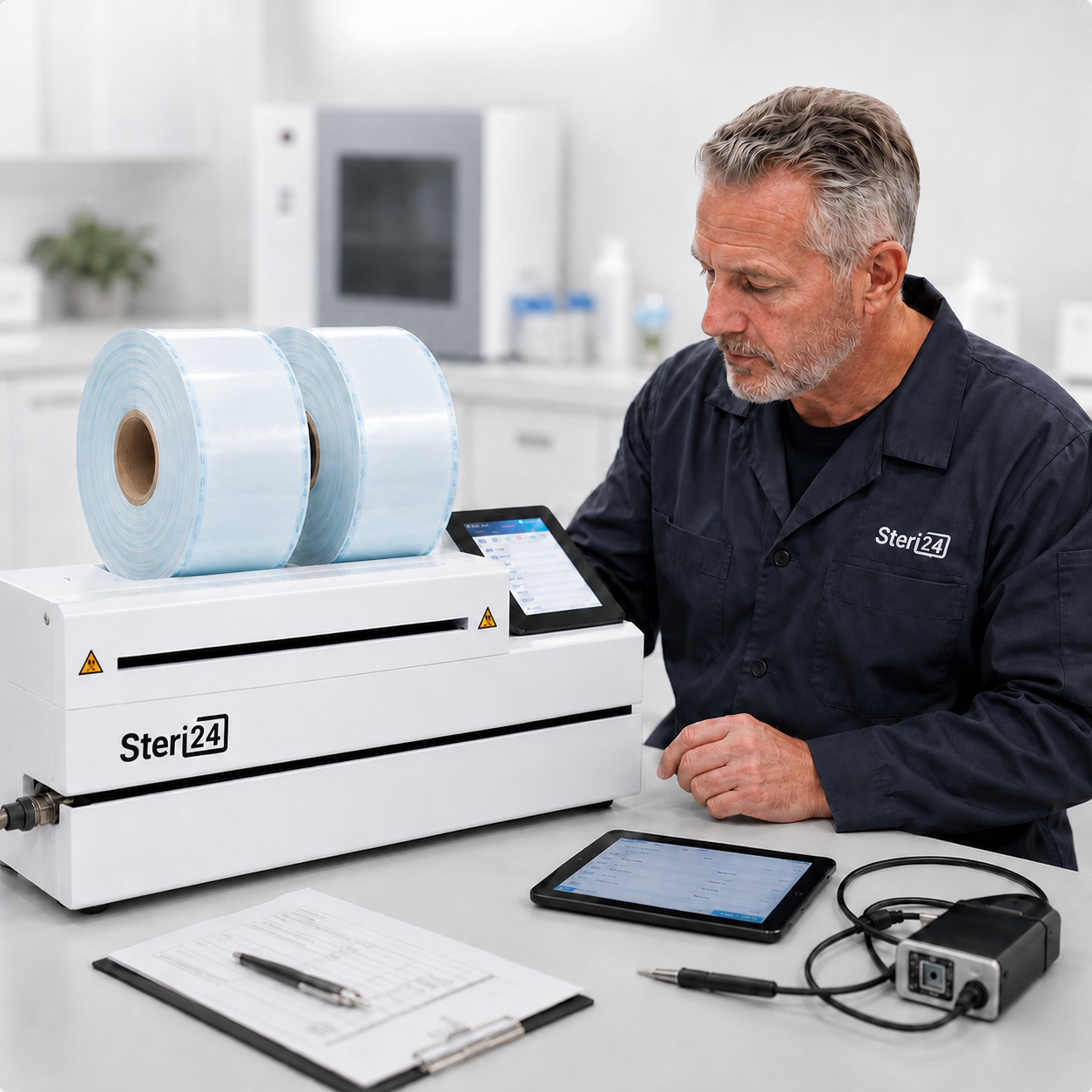
Sealer validation is a formal process verification proving that your sealing process reproducibly produces tight seal seams that act as an effective sterile barrier. The relevant parameters of temperature, contact pressure and time are checked, as is the actual seam quality - documented in an audit-proof report.
Why does the sealing process have to be validated?
DIN EN ISO 11607-2 requires the validation of all packaging and sealing processes. In conjunction with the MPBetreibV, the rule is: non-validatable or non-validated sealing processes are not permitted for reprocessing intended for use on humans. Validation proves that your sterile barrier is reliably tight.
According to which standard is the sealer validation carried out?
Validation is carried out in accordance with DIN EN ISO 11607-2, the standard for the validation requirements for forming, sealing and assembly processes of sterile barrier systems. In addition, the requirements of the MPBetreibV must be observed.
Do you also validate sealers from other manufacturers?
Yes. We validate the sealing process independently of the manufacturer - no matter which supplier your sealer comes from. Our certified technicians carry out the validation in accordance with the standards, without the detour via the device manufacturer.
Do I have to coordinate several points of contact for the validation?
No. You have one point of contact for the entire validation of your sealer - manufacturer-independent and on site. This saves you the detour via the device manufacturer and simplifies scheduling.
What does IQ mean in sealer validation?
IQ stands for Installation Qualification. It checks whether the sealer is correctly set up and connected as well as ready for use. It forms the basis for the further qualification stages.
What does OQ mean in sealer validation?
OQ stands for Operational Qualification. The sealing parameters of temperature, contact pressure and time are verified with calibrated measuring equipment in order to prove that the device operates within the intended range.
What does PQ mean in sealer validation?
PQ stands for Performance Qualification. Here the seal seam quality is proven with real pouches - for example via peel test and ink test - including validation report and inspection sticker.
What is a peel test in validation?
In the peel test, a sealed package is pulled open in a controlled manner in order to assess whether the seal seam separates evenly and without fibers. This allows the strength and quality of the seal seam to be assessed.
What does the ink test check?
In the ink test, a test liquid is used to check the tightness of the seal seam. If no ink penetrates the seam, the sterile barrier is considered tight at that point. It complements the peel test within the performance qualification.
Which parameters are measured during seal validation?
The parameters decisive for a tight seal seam - temperature, contact pressure and time - are checked. These are verified with calibrated measuring equipment and documented in the validation report.
Do I receive documentation after the validation?
Yes. You receive a complete, audit-proof validation report that withstands any hygiene audit and any inspection. In addition, the device is marked with an inspection sticker.
Is sealer validation mandatory?
For establishments that reprocess instruments for use on humans and package them in sterile barrier systems, validation of the sealing process is mandatory under DIN EN ISO 11607-2 and the MPBetreibV. We are happy to clarify in a brief consultation whether the requirement applies to your area of use.
Can sealers be validated at all?
Validatable sealers can be fully validated, since their parameters can be recorded by measurement and are reproducible. Validatable in-house brand devices such as the CertoSeal are validatable in accordance with the applicable requirements.
How does the on-site sealer validation work?
Our technicians come to you directly with calibrated measuring equipment and go through the three qualification stages IQ, OQ and PQ. Your device stays ready for use, and at the end you receive an audit-proof validation report.
Does my sealer have to be sent in for validation?
No. The validation takes place on site at your practice. There is no shipping and no device downtime - our technicians bring the calibrated measuring equipment with them.
Does my sealer stand idle during the validation?
No. The validation takes place on site and can be scheduled during ongoing practice operation. Your sealer stays ready for use, so there is no downtime.
How often does the sealing process have to be revalidated?
The sealing process is revalidated at regular intervals; the exact deadline depends on the device type and on national requirements in Germany, Austria and Switzerland. On request, we will remind you in good time of the next due revalidation.
Do you offer a reminder service for revalidation?
Yes. We offer a reminder service that reminds you in good time of the next due revalidation. This way there are no gaps in your documentation.
In which countries do you offer sealer validation?
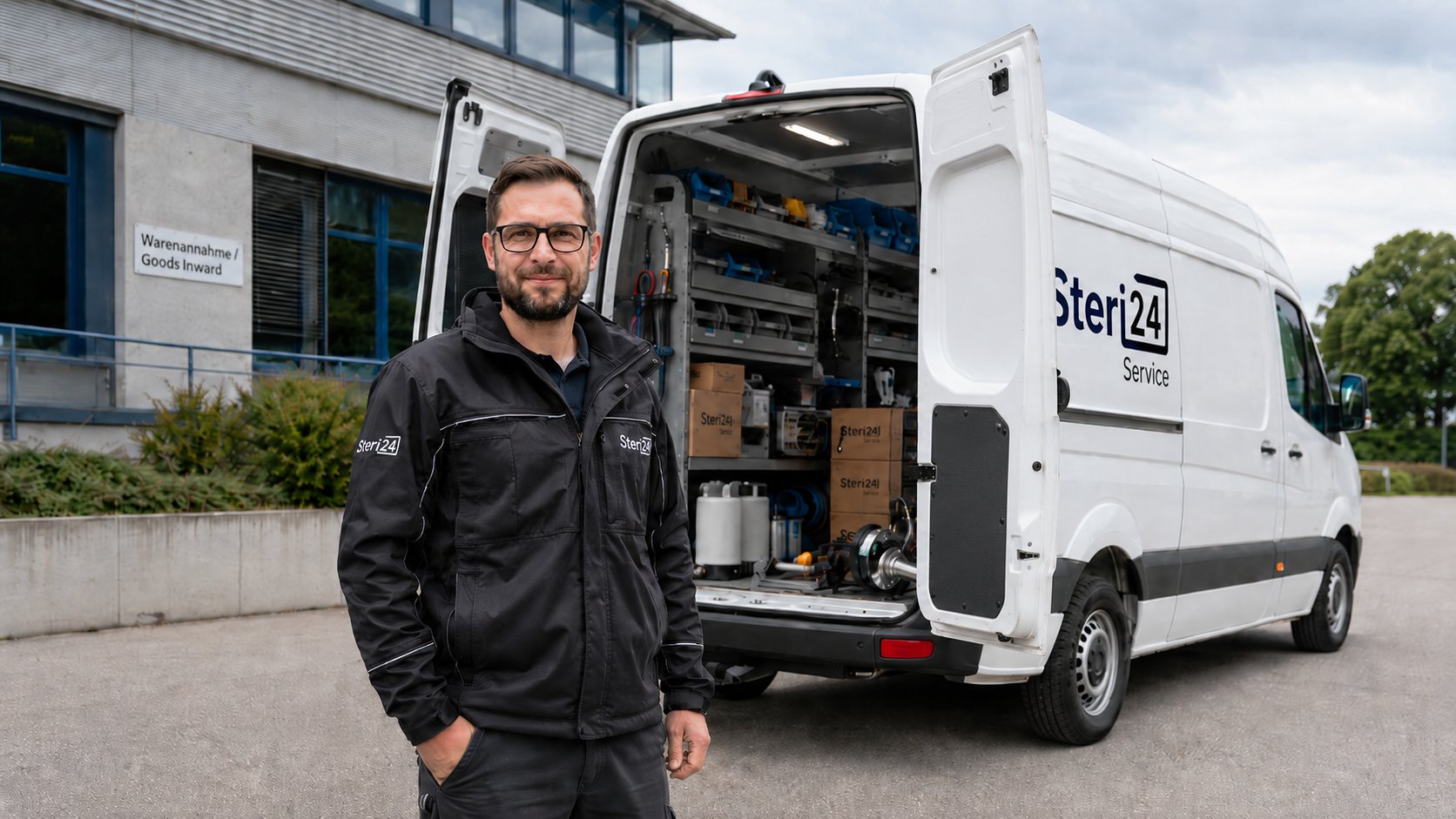
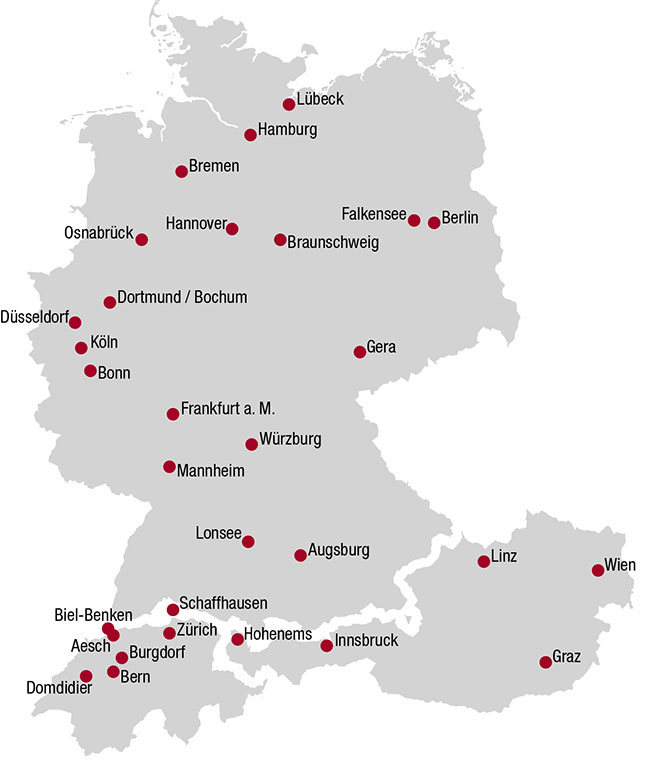
We validate on site in Germany, Austria and Switzerland. For this, a dense service network with our own service vehicles and trained technicians is available.
Does someone come by in person for the validation?
Yes. You receive a personal point of contact in your region who comes to you with calibrated measuring equipment. Thanks to the dense service network, there is usually a technician near you.
How many service locations are there?
Around 39 service locations are available, each with its own service vehicle, as well as over 150 certified partners in the DACH region. This means the journey to you is short and easy to schedule.
What does sealer validation cost?
The costs depend on the location and the device. We are happy to prepare an individual quote for you - contact us for a brief consultation.
Why should I have the validation carried out independently of the manufacturer?
Manufacturer-independent validation bundles all devices with one point of contact and makes you independent of the device manufacturer's service schedule. This simplifies planning and speeds up the on-site appointments.
Does the validation documentation withstand an inspection by the public health authority?
Yes. You receive a complete, audit-proof validation report that withstands any hygiene audit and any inspection. You can present it directly to the responsible authority.
What happens if the seal seams are not tight during the test?
If deviations are detected, we document them and discuss the necessary corrections to the sealing parameters or to the device with you before the validation is completed. This ensures that only a demonstrably tight process is released.
Do I also have to check the tightness of the seal seams during ongoing operation?
Yes. According to the KRINKO recommendation, the tightness of the seal seams must be demonstrated at least by simple checks during the course of reprocessing, supplemented by a visual inspection immediately before use. Periodic validation does not replace these batch-related routine checks.
What is the difference between maintenance and validation for a sealer?
Maintenance is the technical upkeep of the device, such as the replacement of wear parts. Validation is the formal verification that the sealing process meets the standards and reliably produces tight seams. Both are separate, recurring services.
At what interval do sealers have to be maintained?
In accordance with the legal requirements in Germany, Austria and Switzerland, sealers are usually maintained every 24 months. In addition, continuous sealers must be maintained at the latest after a certain number of sealing operations.
Can you offer maintenance and validation of the sealer together?
Yes. We offer both the maintenance and the validation of the sealing process and can carry out both on site. This way you have one point of contact for both services.
What is a process validation for a sealer?
Process validation proves that the entire sealing process - not just a single sealing operation - reproducibly produces tight sterile barriers under real conditions. It is offered for validatable sealers, autoclaves and washer-disinfectors.
What is a sterile barrier system?
A sterile barrier system is the minimum packaging that protects the sterilized medical device from recontamination until use - for example a sealed clear-view pouch. The seal seam is the decisive tight element that the validation checks.
Which packaging can I seal with a validated sealer?
With a validated sealing process you typically seal sealable clear-view pouches and reels that are suitable for your sterilization method. We are happy to advise you on which pouch widths and types suit your instruments.
What happens if I do not validate the sealing process at all?
A non-validated sealing process is considered impermissible for reprocessing intended for use on humans and can be objected to during an inspection. Validation provides the necessary compliance certainty here and an audit-proof record.
Is it enough to validate only the autoclave?
No. If you package sterile goods, then in addition to autoclave validation, validation of the sealing process is also required, since the tight packaging is part of the sterile barrier. Both processes can be coordinated on site.
Can I carry out the sealer validation myself?
No. The validation requires calibrated measuring equipment and must be carried out by trained, certified personnel. You do, however, carry out the ongoing visual inspection of the seal seams before use yourself.
How quickly is a validation appointment available?
We coordinate delivery and validation appointments individually with you; thanks to the dense service network, an appointment near you can usually be found promptly. Leave us your contact details for a callback.
Do you also carry out the initial validation of a newly purchased sealer?
Yes. Validatable sealers should undergo an initial validation before regular use. We carry out this initial validation on site and document it in an audit-proof manner.
Does a used sealer have to be revalidated at the new location?
Yes. Since validation checks the actual conditions at the place of use, a used or relocated sealer should be revalidated at the new location and then revalidated at the intended intervals.
What distinguishes a validatable from a non-validatable sealer?
A validatable sealer records and monitors the sealing parameters measurably and reproducibly, so that the process can be proven in accordance with the standard. Simple sealers without this monitoring cannot be validated within the meaning of the standard.
How long does an on-site sealer validation take?
The duration depends on the device and the scope and can be scheduled during ongoing practice operation. We coordinate the exact time required individually with you when arranging the appointment.
Do I get an inspection sticker after the validation?
Yes. After successful performance qualification, your sealer receives an inspection sticker, in addition to the complete validation report. This way the valid validation status is recognizable at a glance.
Can you also validate a continuous sealer?
Yes. Continuous sealers with continuous sealing can also be validated; in addition, they must be maintained at the latest after a defined number of sealing operations. We will discuss the appropriate procedure with you.
What do I have to prepare for the validation appointment?
As a rule, we need details about your sealer and the packaging materials used. Our technicians bring the calibrated measuring equipment with them - you only need to keep the device accessible.
Why is manufacturer-independent validation useful if I have devices from different suppliers?
You have your autoclave, washer-disinfector and sealer validated from a single source, instead of coordinating a separate service for each device. This saves appointments, interfaces and effort in the documentation.
What does a complete service offer compared to the service of individual manufacturers?
Established device manufacturers often tie the service to their own devices and service schedules. A manufacturer-independent complete service, by contrast, validates all brands on site via a dense regional network - one point of contact for all devices.
Does the validation help me with liability towards patients?
Validation demonstrably documents that your sealing process is tight in accordance with the standards and reproducibly. This audit-proof record is an important building block of your compliance and your protection during audits and inspections.
What if I am not sure whether I have to validate?
Whether a validation obligation applies to your establishment depends on the area of use - in particular on whether you reprocess and package critical instruments for use on humans. Describe your situation to us, then we will clarify it conclusively in a brief consultation.
Does the validation also cover the loading and real pouches?
Yes. In the performance qualification, the seal seam quality is proven with real pouches, that is, under practice-oriented conditions. This way the validation report reflects your actual everyday packaging.
How do I request a quote for sealer validation?
Leave us your contact details and information about your sealer; we will get back to you with an individual quote and coordinate the delivery or validation appointment with you. We are also happy to advise you on the right packaging solution.