Legal Requirements & Overview
The reprocessing of medical instruments is regulated by law. It is based on the IfSG, MPBetreibV and the KRINKO/BfArM recommendations for maximum patient safety.

Use the free ClavioSoft to run an audit check of your practice in just a few minutes – the software automatically generates any missing documentation. This saves you up to 90 % of the work.


The reprocessing of medical instruments is regulated by law. It is based on the IfSG, MPBetreibV and the KRINKO/BfArM recommendations for maximum patient safety.

After use, coarse contamination is removed immediately. This ensures the subsequent disinfection remains effective and hygienically safe.

Residues are removed manually or mechanically using validated agents. Temperature, dosage and contact time ensure successful results.

Regular care protects function and service life. Joints and hinges are treated with special care oils.

Sterile barrier packaging protects instruments until use. Each batch is sealed in a germ-tight manner and clearly labelled.

Sterilization is carried out under controlled pressure, temperature and time. Only validated processes guarantee complete elimination of microorganisms.

Every sterilization cycle is checked and released. Complete documentation ensures seamless traceability.

Clean, dry storage maintains sterility. Storage duration depends on packaging and environmental conditions.

Each batch is documented with sterilization date, expiry date and the responsible person – using a colour-change indicator.

Every instrument is assigned to a patient – for legally compliant traceability and quality assurance.

The hygiene room separates clean and contaminated areas. Equipment and workflows follow the KRINKO requirements.

Before use, it is verified that the autoclave sterilizes reliably. Only validated equipment is RKI-compliant.
Real questions from practices, clinics and studios — clearly answered.
Anyone using reusable medical devices on patients must reprocess them – the legal basis is MPBetreibV § 8 and the KRINKO/BfArM recommendation. This is mandatory whenever critical instruments that come into contact with blood or mucous membranes are used. Those who exclusively use non-critical products are generally not affected.
The classification is based on patient contact: non-critical = intact skin only, semi-critical = mucous membranes, critical = penetrates skin/mucous membranes (blood contact). Semi-critical and critical are further subdivided into A/B (critical also C). The class determines the required depth of reprocessing.
Critical instruments are sterilized in packaging to maintain their sterility until use. Non-critical and semi-critical instruments may be reprocessed without packaging; mixed loads are possible.
For wrapped, hollow and porous (critical) instruments, a steam sterilizer of Klasse B with fractionated vacuum is the prescribed standard (DIN EN 13060), because it fully evacuates even narrow lumens. Class S devices cover only a limited range of applications.
A WD/washer-disinfector handles cleaning and disinfection but does not replace sterilization. Critical instruments must subsequently be sterilized in a Klasse B autoclave.
Distilled or demineralized/deionized water (conductivity preferably below 15–20 µS/cm). Tap water is unsuitable and can damage the device; a water treatment system ensures consistent quality.
Labelling takes place after sterilization; at a minimum, the batch number, sterilization date and use-by date must appear on the packaging. Release is carried out by trained personnel after visual inspection and complete documentation (KRINKO 2.2.7/2.2.8, MPBetreibV).
Store dry, dust-protected and separated from non-sterile material (max. approx. 60 % relative humidity). Guidelines: unprotected max. 48 hours, protected up to 6 months (DIN 58953), following the first-in-first-out principle. Damaged or moist packaging is considered non-sterile.
Yes, reprocessing must be performed using validated processes (MPBetreibV § 8). After the initial validation at commissioning, regular revalidation follows – typically every 24 months or after 1,000 cycles; large devices or heavy utilization may require shorter intervals.
Find out in just a few minutes how well prepared you are for the next inspection — category by category, with clear progress tracking and specific open items. Completely free with ClavioSoft.
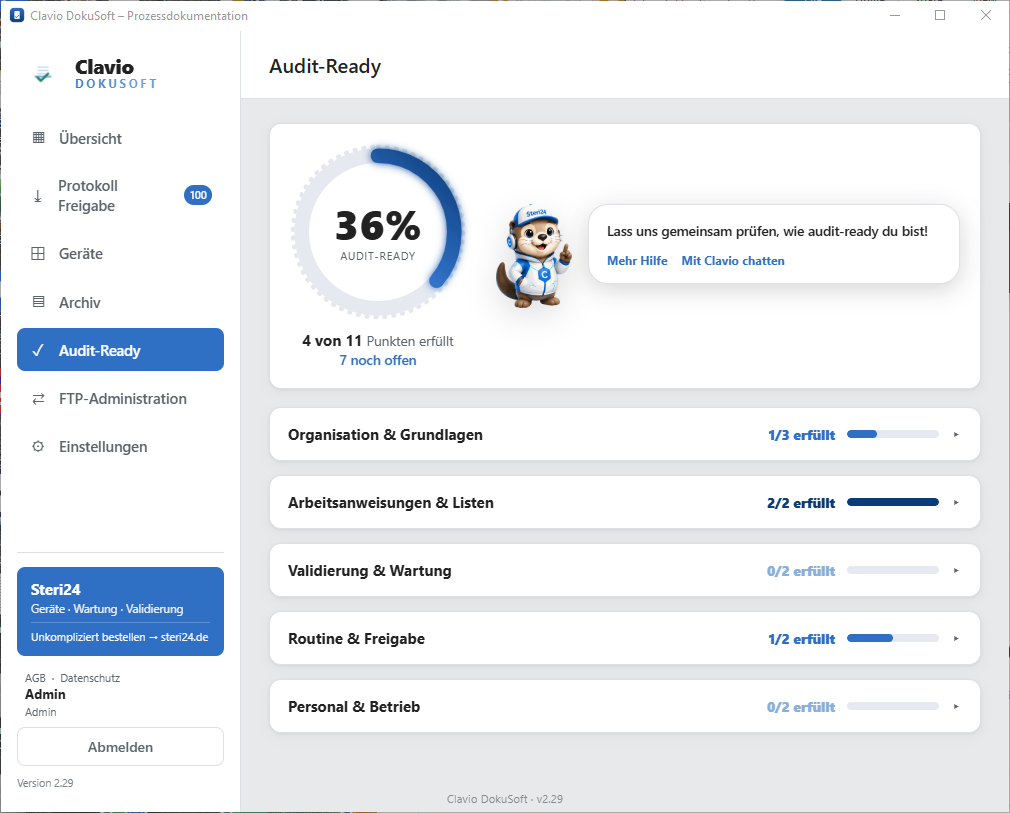
Instrument reprocessing documentation for devices of all manufacturers
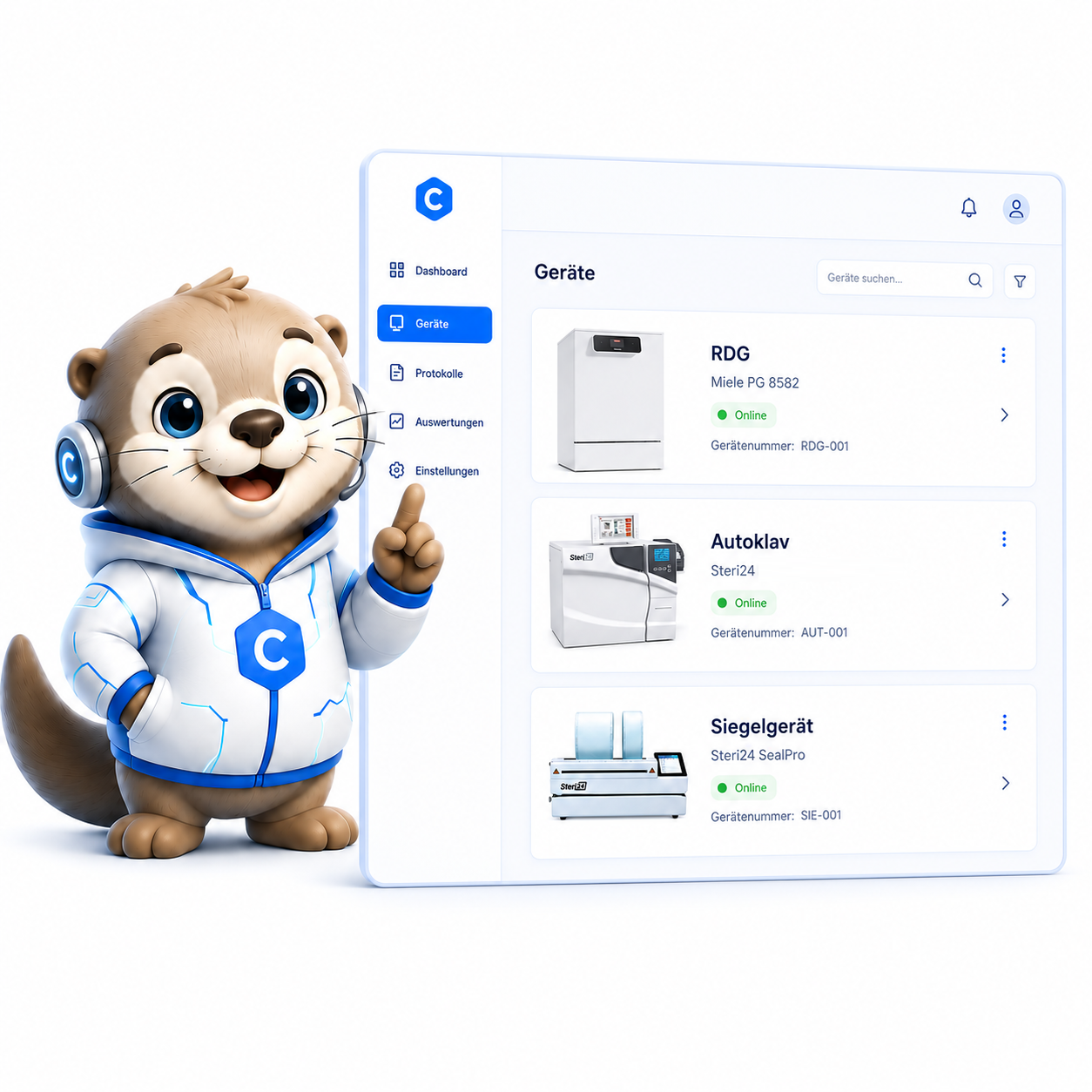


Instrument preparation according to RKI – key questions answered clearly.