Knowledge base
FAQ & Wiki: Everything about instrument reprocessing
Validation, buying advice, operation, documentation — clearly explained by experts with over 60 years of experience. Find the answer to your question fast.
Germany Austria Switzerland
Knowledge by topic
Four areas — from the buying decision to everyday operation.
Law & obligations
Validation, RKI & audit-proof documentation — safe through every inspection.
View
Which autoclave is right?
Class B, size, Pro or Premium — choose correctly.
View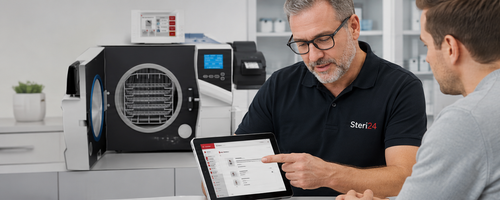
Operation & service
Commissioning, water, error codes & maintenance.
View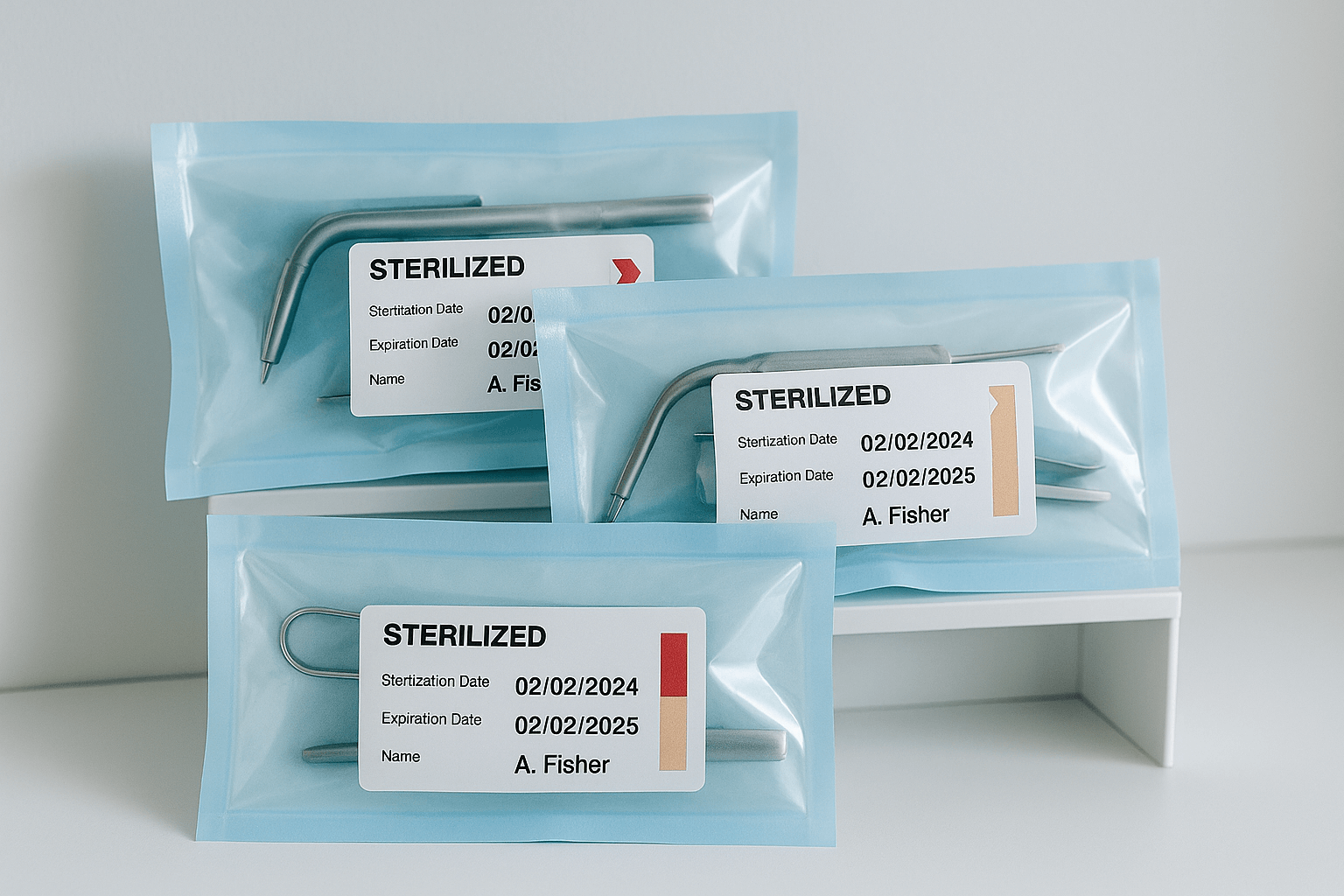
Documentation & software
Paperless RKI documentation with SteriTrace — for any practice software.
ViewKnowledge by sector
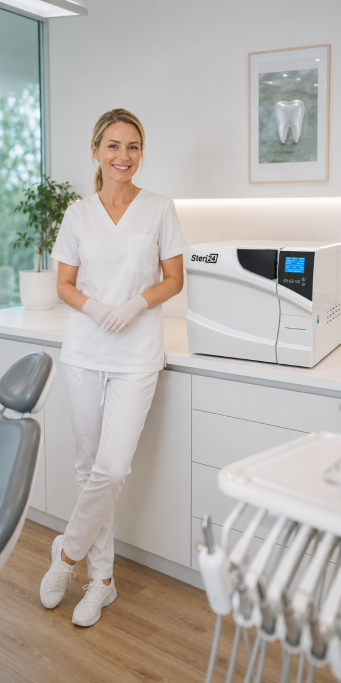
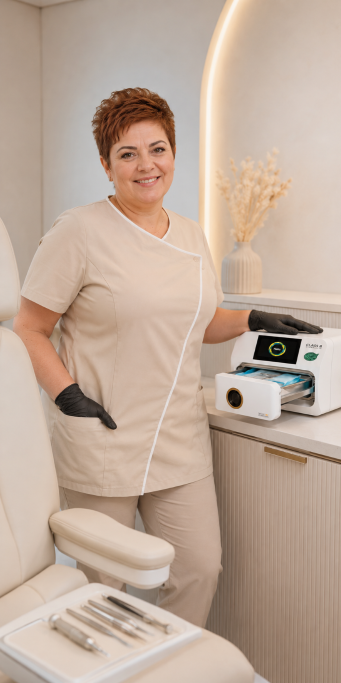
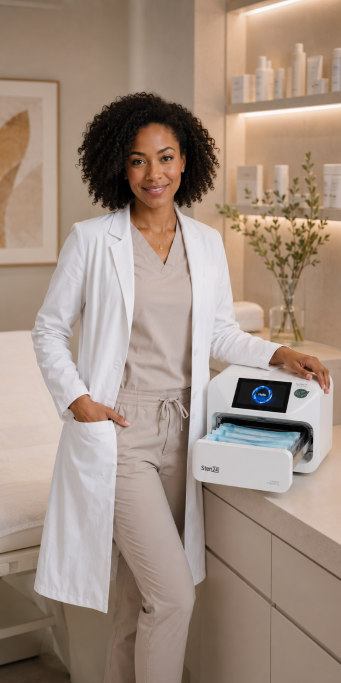
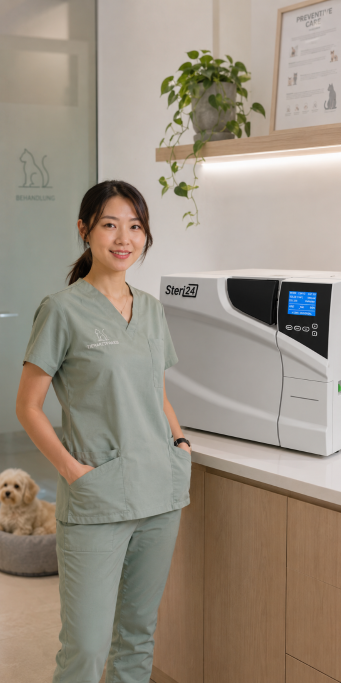
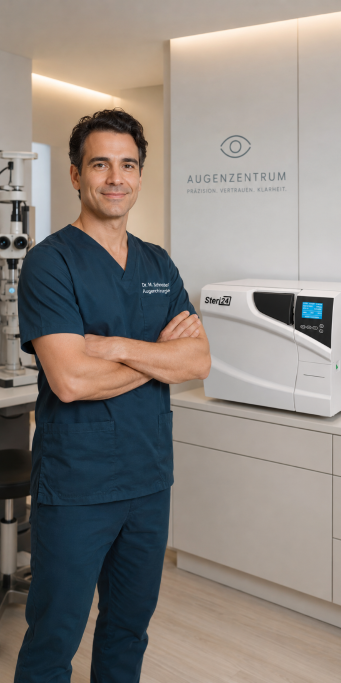
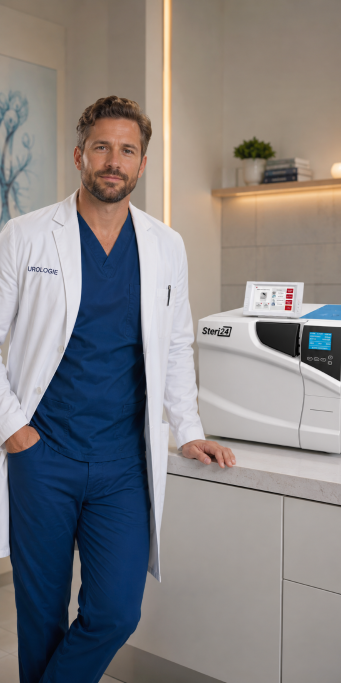
From the beauty studio to the clinic – Steri24 is at home in every specialty.
Not sure which device really fits?
Find the right model in 2 minutes — no jargon, no risk. The configurator guides you step by step.
What our customers say
4.9 out of 5 stars on Google — from verified reviews.
MK
Maud Kolb · Google
„Fast delivery, good advice, great price. Maintenance and validation nearby. I'm happy. Thank you!“
SG
Stephanie Grebe · Google
„I am very positively impressed by the very good, honest, patient advice. I felt I was in good hands.“
4.9 out of 5 on Google Class B medical device · EN 13060 · TÜV SÜD 39 locations + 150 partners in DACH Family business since 1957


1 to 5 (from a total of 5)
Frequently Asked Questions
FAQ & Wiki – key questions answered clearly.
What does Class B mean in an autoclave?
Class B refers to fully featured steam sterilizers with a fractionated vacuum process that reliably sterilize wrapped, hollow and porous instruments as well. For instrument reprocessing in medical facilities, a Class B device is mandatory in Germany.
What is the difference between Class A, B and N autoclaves?
Class B offers full sterilization with a vacuum process for wrapped, unwrapped, hollow and porous instruments. Class N may only sterilize unwrapped, solid instruments and is not permitted in human medicine. For medical practices you need a Class B device.
What is an autoclave and who needs one?
An autoclave is a steam sterilizer used to reprocess medical instruments for reuse. It is needed wherever critical instruments are used that penetrate the skin or mucous membranes or come into contact with blood, for example at dentists, in podiatry, foot care or in tattoo studios.
Which autoclave suits my specialty or practice?
Our Class B autoclaves are suitable for all medical specialties; the right size depends on the quantity and length of instruments per cycle. It's best to fill in our autoclave configurator or get brief advice by phone, then we will recommend the right device specifically for you.
Which autoclave is suitable for foot care, cosmetic or nail studios?
For foot care, cosmetic and nail studios the Class B Pro 3L (small, fast, compact) is usually the most popular choice. From around 8 treatments per day or with several staff members we recommend the 12L Pro with four times the volume. The configurator helps with the precise selection.
Which autoclave is suitable for a dental practice?
For dental practices we usually recommend the 18L or 23L Class B depending on the number of practitioners and instrument volume; for several practitioners a device with documentation and practice software connectivity (Premium). For around 15 individually wrapped instruments the 12L is often sufficient. It's best to use the configurator.
Which autoclave is suitable for a gynaecological practice?
For gynaecological practices we usually recommend the 23L autoclave (Pro or Premium), since instruments such as specula are relatively large and need a lot of space; for lower demand an 18L is also sufficient. The configurator helps you find the right device.
Which autoclave is suitable for a veterinary practice?
Our Class B autoclaves are suitable for veterinary medicine; most veterinary practices order the 12L or 23L Pro, and for very low demand possibly the 3L. For veterinary practices validation is generally not required.
Which autoclave is suitable for a tattoo or piercing studio?
Tattoo and piercing studios need a Class B autoclave. The most popular are the 3L or 12L Pro; for sole operators the 3L is often enough, and for higher volume the 12L. Self-sealing pouches and a value accessory bundle go well with it.
Which autoclave is suitable for a general, internal medicine or dermatology practice?
Our Class B autoclaves are suitable for medical, general, internal medicine and dermatology practices; depending on instrument quantity and size, the 12L or 23L is usually the right choice, or the 3L for low volume. The decisive factors are the largest instrument and the quantity per cycle.
Which autoclave size do I need and how many instruments fit inside?
The right size depends on the quantity and length of instruments per cycle: the 3L has 2 trays, the 12L 3 trays (approx. 18 wrapped instruments), the 18L and 23L 5 trays each. The 23L holds up to about 20 unwrapped instruments per tray. For a precise recommendation, use the configurator.
What is the difference between the Pro and Premium autoclaves?
The autoclave and operation are basically the same. The Premium models additionally offer a fixed water connection, WLAN/LAN connectivity to the practice software, as well as paperless batch release and documentation directly on the touchscreen (SteriTrace). With the Pro, documentation is done via an integrated printer/USB and manual water filling.
What is the difference between the 3L and the 12L autoclave?
The 12L offers four times the volume and an integrated wastewater tank (no external canister needed); the quick program takes a little longer. Technically the devices are otherwise identical. The 3L is more compact and faster.
Which is the smallest Class B autoclave?
The smallest Class B autoclave is the 3L Pro, a very compact device with internal water tanks. We do not offer a truly portable autoclave, but thanks to its compact design the 3L is easy to transport.
Which Class B autoclave sizes are available?
We offer Class B autoclaves in 3L, 12L, 18L, 23L and 45L, each as a Pro or (for the medium sizes) Premium variant. The largest device is the Class B Pro 45L. Current models and prices can be found in the online shop.
Do I need an autoclave or is an ultrasonic, UV or hot-air device enough?
As soon as instruments come into contact with blood or mucous membranes (critical instruments), a Class B autoclave is mandatory; ultrasonic, UV and hot-air devices are not sufficient for this. The ultrasonic cleaner complements the autoclave during pre-cleaning, but does not replace it.
Is a washer-disinfector enough or is an autoclave also needed?
A washer-disinfector (WD) cleans and disinfects semi-critical instruments, but does not replace the sterilization of critical instruments in the autoclave. For instruments that enter sterile body cavities, sterilization in a Class B autoclave is mandatory.
Do you also offer washer-disinfectors (WD)?
Yes, we offer washer-disinfectors/WDs, some also as under-counter or built-in versions. Combined with the Class B autoclave, this covers the entire reprocessing cycle. You can get advice via the configurator or by phone.
Do you offer ultrasonic cleaners and which ones are medical devices?
Yes, we carry ultrasonic cleaners. The professional units are classified as medical devices, while the lower-priced models are not medical devices, but are suitable for manual instrument reprocessing and the gentle cleaning of sensitive products.
Do you offer used devices or display models?
As a rule we only offer new devices with a warranty; we generally do not carry used devices. Occasionally there are individual demo devices with a small discount. When you buy from us, you benefit from on-site installation, maintenance and repair.
Do you have a comparable autoclave as a replacement for an older device from another brand?
Yes, our Steri24 Class B autoclaves to EN 13060 are comparable to the established expensive manufacturers, yet significantly cheaper and with free delivery. As a replacement for a 17/18L device the 18L Pro fits, and for 22/23L devices the 23L. We're happy to find the right replacement together with you.
When is validation of the autoclave mandatory (initial validation)?
Initial validation is mandatory as soon as you sterilize critical instruments, i.e. instruments that penetrate skin/mucous membranes or come into contact with blood. It must be carried out on site in your practice (generally within max. 3 months) and applies to all users who reprocess instruments in human medicine.
What does validation of an autoclave mean?
Validation is the documented proof that your device delivers reproducibly sterile results under practice conditions. The initial validation assesses the entire reprocessing process and is mandatory for users in human medicine; it is repeated at fixed intervals through revalidation.
Must validation always be carried out on site?
Yes, the initial validation and revalidation must be carried out on site in your practice on the installed device, because the entire process is tested under real conditions. We organize this through our DACH-wide service network.
Does the autoclave need to be validated in the veterinary field?
For veterinary practices validation is generally not required, since the validation obligation is tied to the reprocessing of critical instruments in human medicine. For a binding assessment of your situation, we are happy to advise you.
Can you also validate or service devices from other manufacturers?
We cannot service third-party devices from other manufacturers, but we can validate them. The prerequisite is that the prescribed maintenance has previously been carried out by the manufacturer or an authorized partner, since this is a basic requirement for revalidation. Send us the model and manufacturer for a quote.
At what intervals must the autoclave be serviced and revalidated?
Maintenance and revalidation take place at regular, defined intervals based on the applicable recommendations and the requirements of your responsible authority. We will inform you transparently about the exact dates and costs as part of a maintenance or validation contract.
Are there service partners or service locations in my region?
Yes. Steri24 has a dense service network in Germany, Austria and Switzerland with numerous locations and partners. This means installation, maintenance, validation and repair are usually possible on site and at short notice.
Do you also offer service and repair after the warranty period has expired?
Yes, we offer service, maintenance and repair even after the warranty has expired, through our DACH-wide service network. This keeps your device ready for use throughout its entire service life.
Is there a loan or replacement device during maintenance or in case of a fault?
Please contact us directly: depending on the situation and location, coverage during maintenance or repair can be arranged. Through the service network we keep downtimes as short as possible.
My autoclave no longer turns on or shows no sign of life - what should I do?
First check the power outlet, power cord and the device fuse. If the device remains unresponsive, please contact our customer service with the model and serial number; our service network will help you quickly.
The sterilized goods are still wet after the program - what can I do?
Common causes are overloading, incorrect loading or a drying step that did not complete fully. Load less densely, leave space between the instruments and select the appropriate program with drying. If the goods remain wet, please contact service.
The device reports poor water quality - what can I do?
Use only distilled or demineralized water with low conductivity (ideally below 15-20 µS/cm) and check the fresh water tank. If the message appears despite correct water, a sensor may be affected - please contact service.
The helix/steam indicator does not show a sterile result (brown instead of black) - what is the reason?
The most common cause is the wrong program: for the helix test (hollow bodies) the Class B program with pre-vacuum must be selected, not the program for unwrapped, solid instruments. If the strip remains brown with the correct program, the device is probably faulty - please contact service.
Does the autoclave need a fixed water connection or can it be filled manually?
A fixed water connection is not necessary. All our autoclaves are stand-alone devices with an integrated fresh and wastewater tank and can be filled manually with distilled or demineralized water. A fixed water connection can be ordered optionally and retrofitted later.
Which water must be used for the autoclave?
Use distilled or demineralized/fully deionized water (conductivity ideally below 15-20 µS/cm). Commercially available distilled water from a drugstore, supermarket or hardware store is suitable. Tap water is not suitable and can damage the device.
How long does a sterilization cycle take?
The duration depends on the model and program: a quick program in the 3L device takes only a few minutes, while full Class B cycles with drying take considerably longer. The exact run time per program can be found in the operating manual of the respective model.
Is a normal power outlet enough or is a high-power supply required?
The common Class B autoclaves run on a normal household outlet; a high-power supply is generally not required. The exact electrical requirements per model can be found in the operating manual or by asking us.
Does the autoclave have to be in a separate room?
A dedicated room is not mandatory, but there are requirements for the installation location, ventilation and the separation of the unclean and clean areas of reprocessing. Ensure sufficient floor space, distance from walls and a stable worktop. We're happy to clarify details in a consultation.
Can I install and commission the autoclave myself?
As a stand-alone solution, the devices are generally easy to set up. However, as soon as you reprocess critical instruments, an initial on-site validation is mandatory; installation, commissioning and instruction can be carried out at the same time. These services can be booked additionally.
Which programs does the autoclave have and is there a short program?
Our Class B autoclaves have several standardized programs for wrapped, unwrapped, hollow and porous instruments as well as a vacuum test; many models additionally offer a fast short program and a prion program. The available programs per model are listed in the manual.
At what temperature are instruments sterilized?
In accordance with EN 13060/KRINKO, steam sterilization typically takes place at 134 °C or at 121 °C with the respective defined holding times. On the larger models the temperature can be set within a range, so that more sensitive autoclavable materials can also be treated gently.
Which materials and instruments can be sterilized in the autoclave?
Suitable are stainless steel instruments as well as heat-resistant plastics marked by the manufacturer as autoclavable; hollow bodies such as handpieces and turbines can also be reprocessed. Non-autoclavable products or those declared single-use do not belong in the autoclave.
How do I load the autoclave correctly?
Do not load too densely, so that the steam reaches all surfaces; the instruments should ideally not touch each other. Heavy instruments at the bottom, lighter ones at the top; the paper side of the sterilization pouches facing up. Observe the permissible load quantity of the model.
Do I have to clean and disinfect instruments before sterilizing?
Yes. Before sterilization, instruments must be cleaned and disinfected - for critical instruments by machine (ultrasonic cleaner or WD/washer-disinfector). Only cleaned, disinfected and, if necessary, wrapped goods go into the autoclave.
Which instruments must be sterilized wrapped and which unwrapped?
Critical instruments are sterilized wrapped (sealed); semi-critical instruments can also be autoclaved unwrapped. The decisive factor is the risk classification according to KRINKO. In case of doubt, instruments are usually considered critical and must be wrapped.
Which risk classes for instruments are there?
Instruments are classified according to RKI/KRINKO into non-critical, semi-critical and critical. Critical A: without hard-to-reach areas; Critical B: with cavities or joints; Critical C: with special manufacturer requirements. The classification determines the necessary reprocessing and sterilization procedure.
How does the reprocessing of medical devices work step by step?
According to the RKI, reprocessing takes place in several steps: risk assessment, preparation/pre-cleaning, cleaning, disinfection (thermal or chemical), packaging, sterilization and release. You can find a detailed guide in our knowledge section.
Is a helix test mandatory and when is it needed?
The helix test is required for critical B instruments (hollow bodies) or wrapped instruments and proves steam penetration. It does not necessarily have to be carried out on every run, but many include it routinely in every batch. For daily routine monitoring of Class B devices it is approved.
How often do I perform the vacuum test?
You should perform the vacuum test yourself, usually once a week in the morning with a cold chamber (with a warm chamber it will not start). It is standardized in EN 13060 and takes around 15-20 minutes depending on the device.