RKI Cleaning and Disinfection

Meet RKI requirements – free of charge

Use the free ClavioSoft to run a quick audit check of your practice in just a few minutes – the software automatically generates any missing documentation. This saves you up to 90 % of the work.

Clavio has an idea
 

Cleaning and Disinfection of Instruments According to RKI


Cleaning and disinfection remove contaminants and reduce the microbial load to a level that allows instruments to be safely processed further – they form the foundation of every standards-compliant sterile supply reprocessing cycle. This step is mandatory for all instruments requiring reprocessing. The KRINKO recommends automated, validatable processes because they are reproducible and verifiable.

1Three Methods – One Goal

Cleaning & disinfection can be carried out in three ways:

1. Manual (chemical) – by hand using cleaning and disinfection solutions.
2. Ultrasonic cleaner (supportive cleaning) – uses cavitation to loosen contaminants even in delicate or hard-to-reach structures; does not replace subsequent disinfection or automated reprocessing in a washer-disinfector.
3. Automated in a washer-disinfector / WD (thermal) – cleans and disinfects in a validated, documented process.

RKI recommendation: Wherever possible, automated, validated processes (washer-disinfector) should be preferred over manual methods – they are reproducible, protect staff and provide documented evidence. For critical B instruments, automated cleaning with thermal disinfection in the washer-disinfector is generally mandatory; manual reprocessing is only permitted if an instrument cannot be reprocessed by machine (or if justified by a risk assessment) – and then exclusively according to a documented, validated standard operating procedure with verified cleaning of inner surfaces as well.
Sources: KRINKO/BfArM 2012, Section 2.2.2; automated processes per DIN EN ISO 15883 (washer-disinfector).

2Which Device for Which Risk Category?

Risk categoryManualUltrasonic cleanerWasher-disinfector
Non-criticalpermitted (time-consuming)permittedrecommended if available
Semi-critical Apermitted (time-consuming)Recommendedrecommended if available
Semi-critical Bpermissible if reproducible cleaning is verified (including inner surfaces)Recommendedpreferred if available
Critical Apermitted (time-consuming)Recommendedrecommended if available
Critical Bonly as a validated, justified exceptionsupportive cleaning (does not replace disinfection)generally mandatory
Critical Chighest requirements: certified QM system (DIN EN ISO 13485) via an officially recognised body, risk analysis (DIN EN ISO 14971) and strict adherence to manufacturer instructions – in-house reprocessing in the practice is generally not applicable
If only a few critical-B instruments are used, more affordable specialist reprocessing devices may be available; we are happy to advise you.

3Manual Cleaning & Disinfection

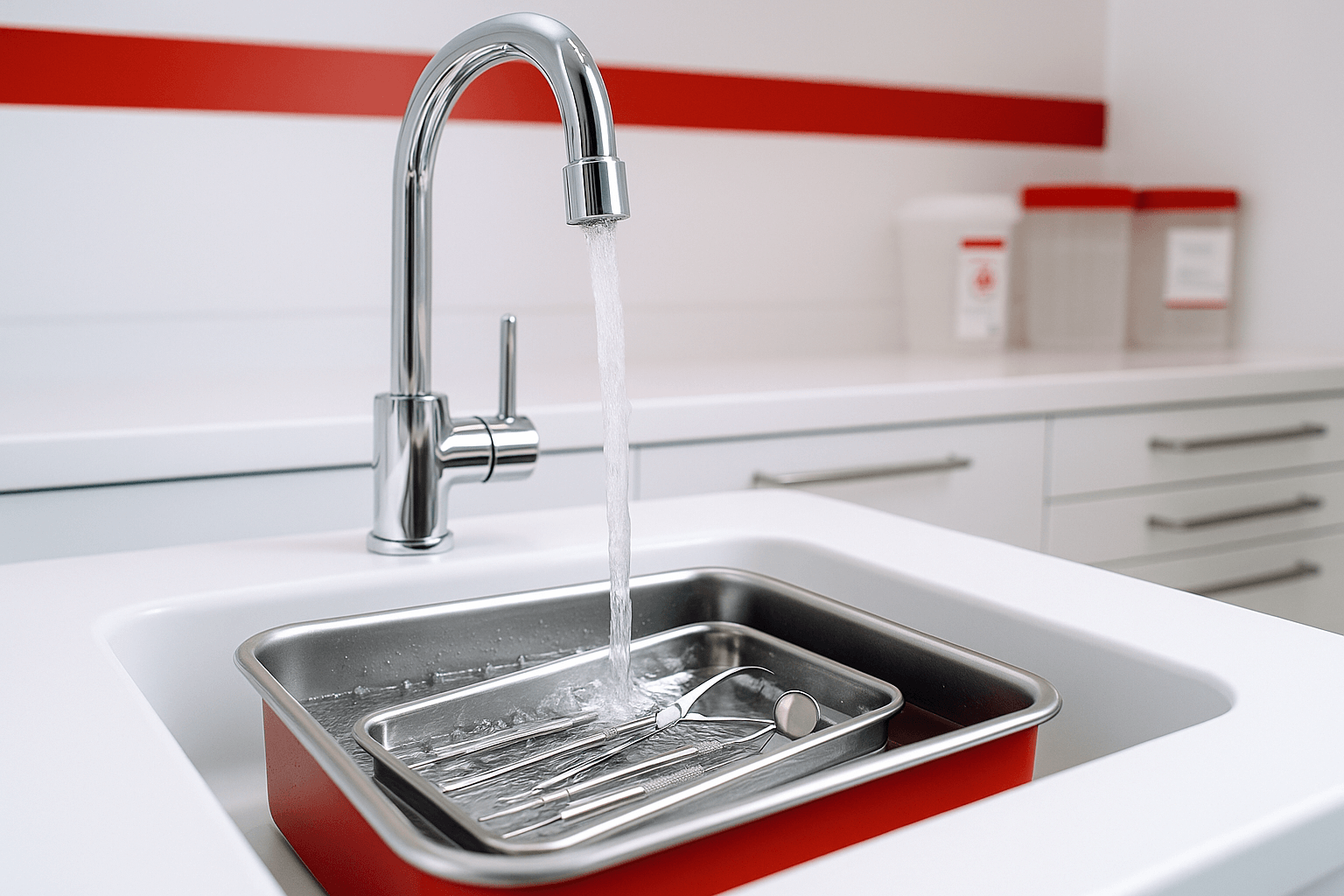
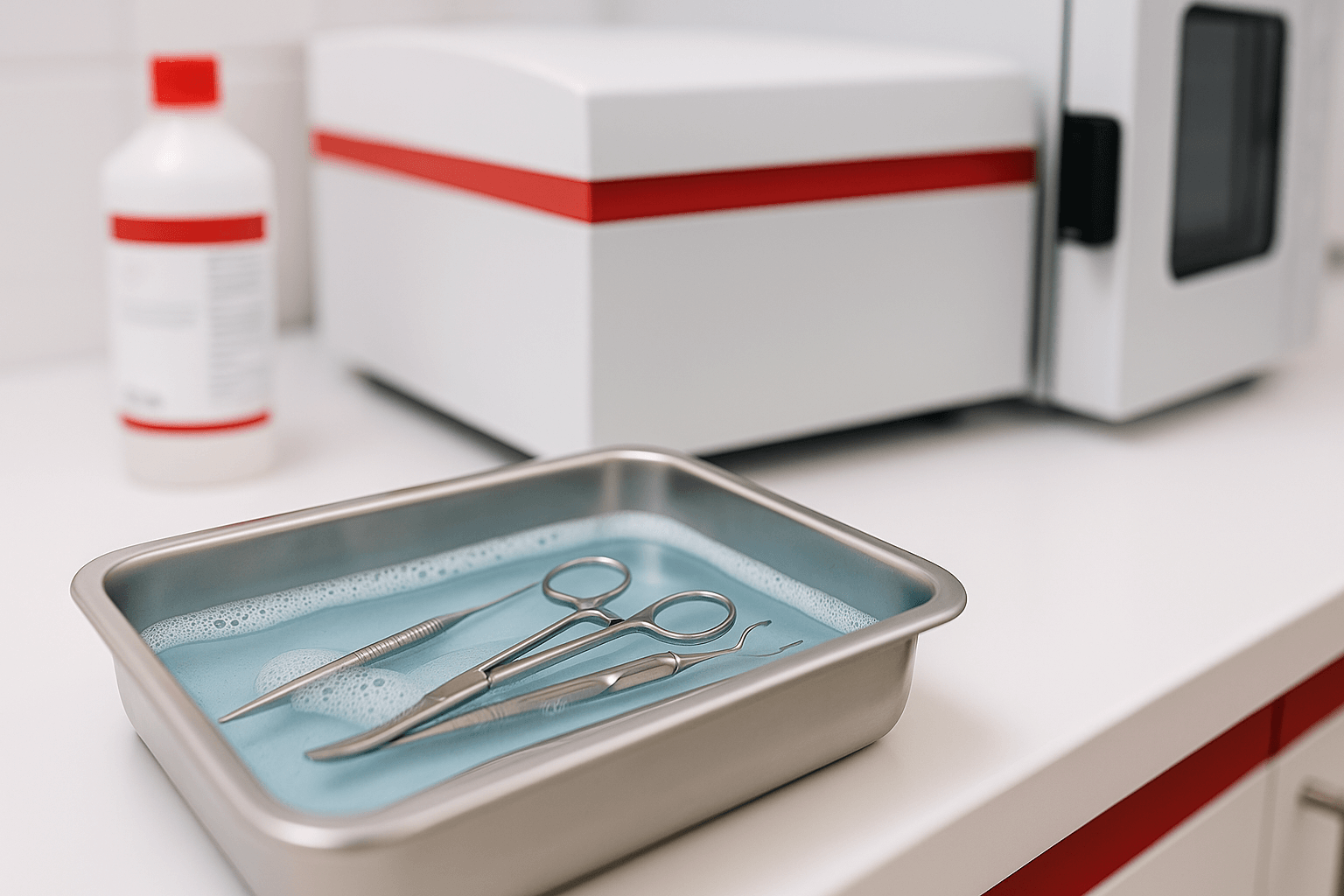
Cleaning: disassemble any instruments that can be taken apart and open all joints. Place them in a tray with a suitable cleaning solution prepared according to the manufacturer's instructions. Clean mechanically with plastic brushesno abrasive agents or scouring pads (risk of damage). Then rinse thoroughly with water until no cleaning-solution residues remain.

Disinfection: immerse in a freshly prepared disinfection solution that is proven to be bactericidal (including mycobacteria), fungicidal and virucidal and is listed in the current VAH list with the required spectrum of activity. Observe the contact time exactly as specified by the manufacturer, then rinse thoroughly again.

Drying: allow to drip-dry and then dry completely with a lint-free cloth or medical-grade compressed air; drying must prevent recontamination – residual moisture jeopardises subsequent sterilisation.

4Automated Processes

Ultrasonic cleaner: uses cavitation to loosen contaminants even in hard-to-reach areas; ideal as a supplement or for delicate instruments. Do not overload the basket; ensure all instruments are fully submerged.

Washer-disinfector (WD): cleans and thermally disinfects in a validated programme. The measure of disinfection efficacy is the A0 value (guideline value A0 ≥ 3000 for critical instruments). The process is fully documentable and therefore ideal for meeting traceability requirements – record your batch documentation in just a few clicks with the free ClavioSoft.

Note: VAH-listed products are approved for manual disinfection; for automated disinfection in the washer-disinfector, efficacy must be demonstrated by the manufacturer's expert report under automated reprocessing conditions. Sources: DIN EN ISO 15883 (washer-disinfector, A0 concept); KRINKO 2012, Section 2.2.2.
Whether you need an ultrasonic cleaner, a washer-disinfector or both – the right setup for your practice depends on your instrument portfolio. Let us put together the perfect configuration for you.
Find the right Class B autoclave

Key Additional Points per RKI & Standards

These points are frequently overlooked in practice but are essential for correct and legally compliant implementation:

  • Pre-treatment / pre-cleaning at the point of use: Gross soiling (blood, secretions, tissue residues) should be removed as soon as possible after use to prevent drying; cleaning should follow promptly. Pre-cleaning agents and methods must be compatible with subsequent reprocessing steps.Source: KRINKO/BfArM 2012, Section 2.2.1 (Pre-treatment, collection, pre-cleaning)
  • No fixating procedures before cleaning: No fixating procedures may be applied before cleaning – in particular no heat and no aldehydes – as these fix proteins/blood and impair cleaning. Fixation of residues must also be avoided during disinfection; therefore: clean first, then disinfect.Source: KRINKO/BfArM 2012, Section 2.2.1 ('Avoidance of fixating procedures such as the application of heat or aldehydes before cleaning') and 2.2.2 (fixating properties of aldehyde, alcohol, peracetic acid, temperatures > 55 °C)
  • Final rinse with purified water (demineralised water): The final rinse must be performed with water of suitable quality; demineralised (DI) water is recommended to avoid deposits and crystallisation on the instrument. The final-rinse water must be free of facultatively pathogenic micro-organisms (microbiologically at least drinking-water quality).Source: KRINKO/BfArM 2012, Section 2.2.2 (Requirements for final-rinse water: freedom from facultatively pathogenic micro-organisms, demineralised water recommended)
  • Validation and standard operating procedures for manual reprocessing: Manual cleaning and disinfection procedures must also be performed according to documented standard operating procedures using agents that have been tested for efficacy and material compatibility and must be validated. Critical process parameters (e.g. concentration, temperature, contact time, rinsing steps) must be defined and verified through periodic checks; the reprocessing instructions provided by the manufacturer (DIN EN ISO 17664) must be observed. Standard operating procedures and the associated documentation can be managed conveniently in one place with the free ClavioSoft.Source: KRINKO/BfArM 2012, Section 2.2.2 (manual procedures according to documented standard operating procedures, validated; critical process parameters to be defined and periodically reviewed); MPBetreibV
  • Visual cleanliness inspection after cleaning: Effective sterilisation can only be guaranteed with clean instruments. After cleaning and disinfection, every instrument must be visually inspected for cleanliness (no visible residues, encrustations or deposits), integrity and function; where particularly high requirements apply, optical magnification aids may be used. Instruments that are not perfectly clean must be reprocessed.Source: KRINKO/BfArM 2012, Section 2.2.2 ('Effective sterilisation can only be guaranteed with clean medical devices'; visual inspection, magnification aids if applicable for critical C)
  • Qualified personnel: Cleaning and disinfection may only be performed by personnel with documented specialist knowledge (instrument science, hygiene/microbiology, risk assessment). For critical-B instruments, proof of recognised training of the person carrying out the reprocessing is additionally required.Source: KRINKO/BfArM 2012, Annex 6 'Specialist knowledge of personnel'; Table 1, Footnote 4 ('Proof of recognised training'); MPBetreibV
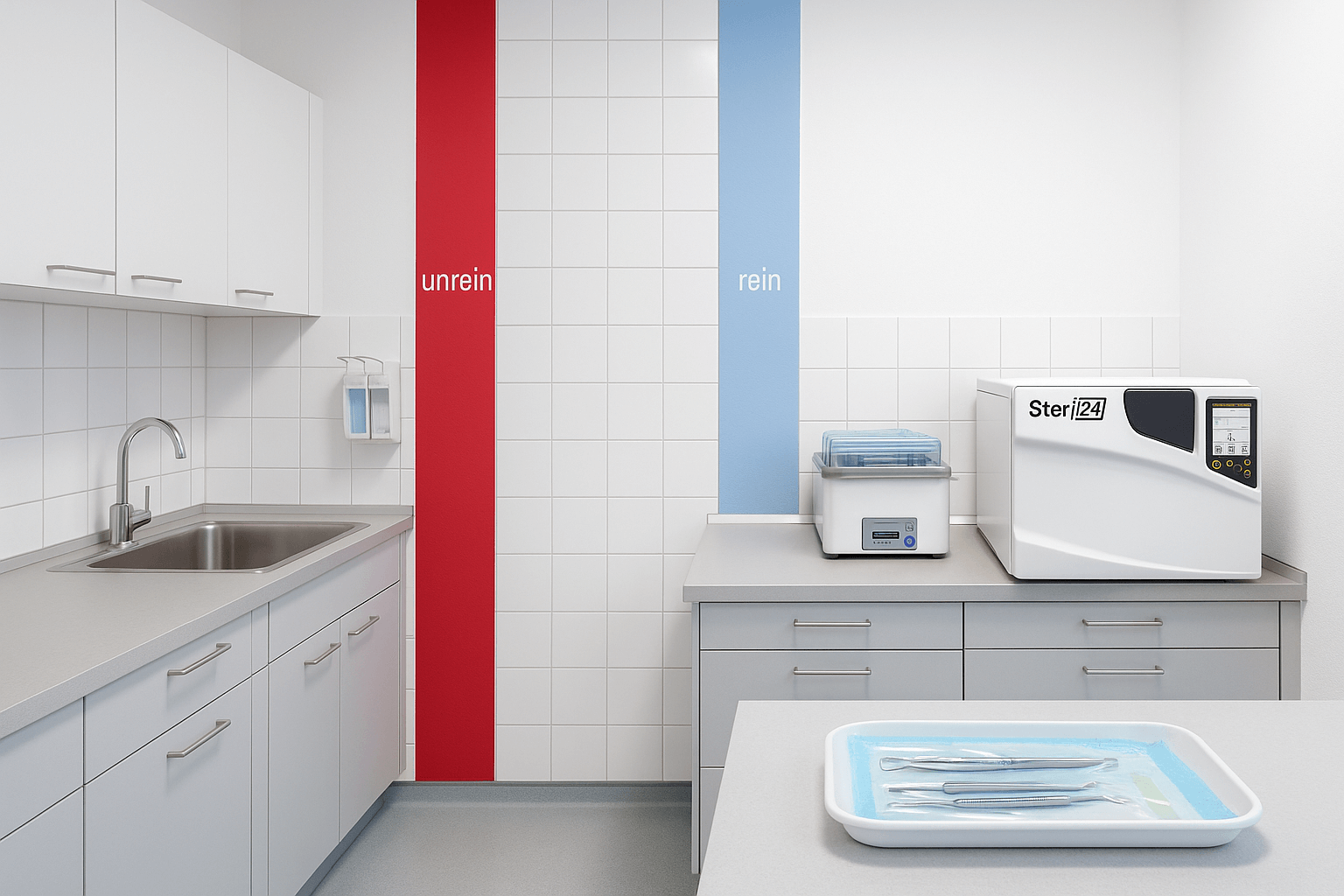
  • Occupational safety / personal protective equipment: During manual reprocessing in the contaminated zone, personal protective equipment must be worn (suitable protective gloves, safety goggles, protective clothing), and adequate room-air quality as well as separation of clean/contaminated areas must be ensured.Source: KRINKO/BfArM 2012, Section 2.2.1/2.2.2 ('Protective clothing, safety goggles, suitable gloves; room-air quality', TRBA 250)
  • Differentiating A0 guideline values (A0 600 / A0 3000): The A0 value describes the efficacy of thermal disinfection in the washer-disinfector. Two guideline values are common: A0 600 for instruments without special requirements, and A0 3000 for critical instruments or those contaminated with highly tenacious pathogens. The target value depends on the risk assessment and manufacturer specifications. This article has so far referred only to A0 ≥ 3000.Source: DIN EN ISO 15883-1 (A0 concept: guideline values A0 600 / A0 3000). Note: The A0 values are defined in DIN EN ISO 15883, not in the KRINKO full text.

Required Equipment, Consumables & Accessories

Checklist for this processing step – items you should have ready (shopping list):

Equipment

  • Washer-disinfector (WD) with a validated programme (A0 concept), type-tested to DIN EN ISO 15883 Order here in the shop
  • Ultrasonic cleaner for supportive cleaning of delicate or hard-to-reach instruments Order here in the shop
  • Water treatment system for demineralised water for a low-mineral, low-microbial final rinse Order here in the shop
  • Medical-grade compressed-air drying device
  • Sinks/trays with separate clean/contaminated zones in the reprocessing room

Consumables

  • Cleaning agent for manual cleaning (instrument-grade, material-compatible, per manufacturer instructions)
  • Instrument disinfectant for manual disinfection – VAH-listed, bactericidal (incl. mycobacteria), fungicidal, virucidal
  • WD process chemistry: machine cleaning agent and, if applicable, neutraliser/rinse aid (WD-compatible, with expert report)
  • Demineralised water for the final rinse Order here in the shop
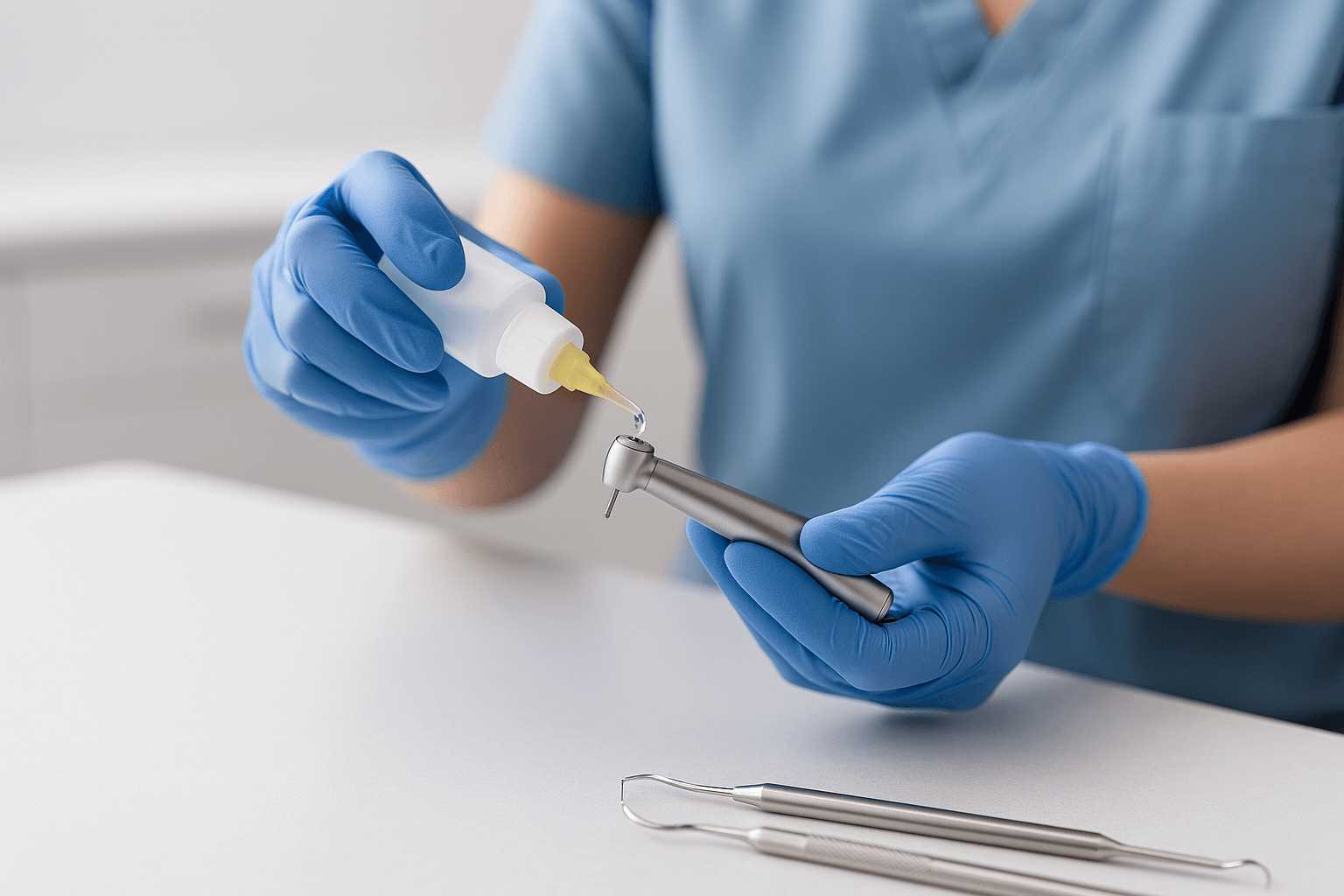
  • Instrument care product/oil (steam-sterilisable) for joints after cleaning Order here in the shop
  • Lint-free, non-shedding drying cloths
  • Plastic/nylon brushes for lumens and hollow instruments (no abrasive agents, no metal brushes)
  • Test strips/indicators for monitoring disinfectant concentration

Accessories

  • Personal protective equipment: liquid-resistant protective gloves, safety goggles/visor, protective clothing/apron
  • Sieve trays/loading baskets and instrument-specific adapters/connectors for the washer-disinfector (hollow-instrument flushing) Order here in the shop
  • Optical magnification aid (magnifying glass) for cleanliness inspection
  • Measuring/dosing aids (measuring cup, dosing pump) for correct preparation of solutions
  • Timer/clock to ensure correct contact time
  • Closed transport container for transporting contaminated instruments
  • Standard operating procedures (SOPs) and documentation templates or digital documentation software for batch and process records Order here in the shop Create digitally with ClavioSoft

Templates & References

  1. KRINKO/BfArM 2012, Bundesgesundheitsbl. 55:1244–1310 – Section 2.2.2.
  2. DIN EN ISO 15883 (washer-disinfectors, A0 value); VAH list.
  3. MPBetreibV § 8; Dental Chamber standard operating procedures.

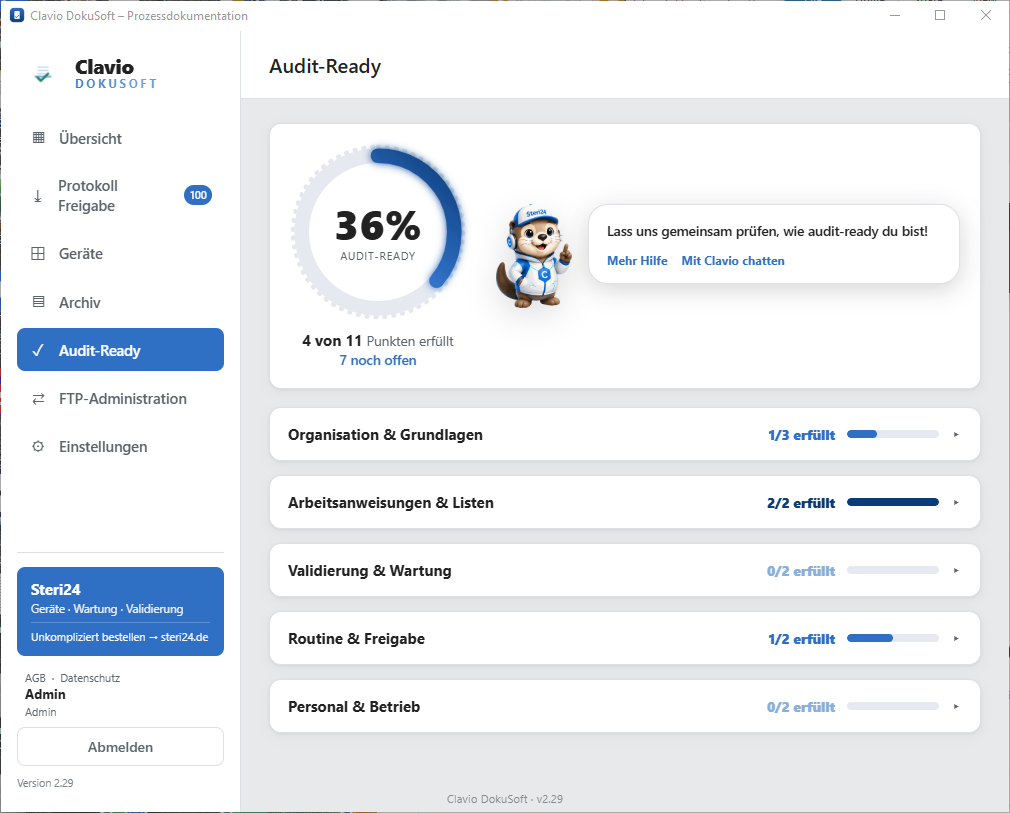
How audit-ready is your practice?

Find out in just a few minutes how well prepared you are for your next inspection — category by category, with clear progress tracking and specific open items. Completely free with ClavioSoft.

ClavioSoft Audit-Ready Check: progress display and categories
Download ClavioSoft for free
Free forever For autoclaves from all manufacturers RKI-compliant

1 to 1 (from a total of 1)

Frequently Asked Questions

RKI Cleaning and Disinfection – key questions answered clearly.
What is the difference between cleaning and disinfection of instruments?
Cleaning removes visible and invisible contaminants such as blood, secretions and tissue residues. Disinfection then reduces the microbial load to a level that allows instruments to be safely processed further. Both steps are mandatory for all instruments requiring reprocessing according to KRINKO/BfArM 2012.
Do instruments need to be cleaned and disinfected before sterilisation?
Yes. Instruments must always be cleaned and, depending on their classification, disinfected before sterilisation. Micro-organisms sheltered beneath soiling can survive and compromise the sterilisation outcome. This step is mandatory for all instruments requiring reprocessing according to KRINKO/BfArM 2012.
What three methods are available for cleaning and disinfecting instruments?
There are three methods: manual chemical reprocessing by hand, supportive cleaning in an ultrasonic cleaner, and automated thermal reprocessing in a washer-disinfector (WD). The KRINKO recommends automated, validatable processes because they are reproducible and documentable.
Why does the KRINKO recommend automated processes over manual cleaning?
Automated, validated processes in the washer-disinfector are reproducible, provide documentable evidence and protect staff from injury and infection risks. Manual procedures are more operator-dependent. Automated processes are therefore preferred according to KRINKO/BfArM 2012.
Is a washer-disinfector (WD) mandatory for critical-B instruments?
For critical-B instruments, automated cleaning with thermal disinfection in the washer-disinfector is generally mandatory. Manual reprocessing is only permissible as a validated, justified exception when an instrument cannot be reprocessed by machine. In such cases, cleaning of inner surfaces must also be verified.
Which device do I need for which risk category during reprocessing?
For non-critical, semi-critical and critical-A instruments, manual methods or ultrasonic cleaners are permissible; a washer-disinfector is recommended. For critical-B, the washer-disinfector is generally mandatory. Critical-C instruments are generally not reprocessed in-house in the practice.
Is an ultrasonic cleaner sufficient for disinfecting instruments?
No. The ultrasonic cleaner uses cavitation to loosen contaminants even in delicate structures, but it only provides supportive cleaning. It does not replace subsequent disinfection or automated reprocessing in the washer-disinfector. Critical instruments must then be disinfected, dried, packaged and sterilised.
How does cleaning in an ultrasonic cleaner work?
The ultrasonic cleaner generates microscopic bubbles through cavitation that, upon collapsing, loosen contaminants even in hard-to-reach areas. It is ideal as a supplement or for delicate instruments. It is important not to overload the basket and to ensure all instruments are fully submerged.
How long and at what temperature should instruments be cleaned in the ultrasonic bath?
Typically around five minutes at approximately 60 degrees Celsius; the optimal temperature can be set on the device. The elevated temperature can shorten the required contact time of the disinfectant. The manufacturer's instructions for the product used are always authoritative.
What do I fill into the ultrasonic cleaner?
The ultrasonic cleaner should be filled with distilled or demineralised water plus a cleaning concentrate certified for medical instruments, usually at approximately 1 to 2 percent dilution. Follow the exact dosage in the product's instructions for use. The solution must be changed according to the manufacturer's instructions.
Does the ultrasonic bath belong to the cleaning or the sterilisation step?
The ultrasonic bath belongs to the cleaning and disinfection step of reprocessing, not to sterilisation. It supports chemical cleaning with solution and water. Critical instruments must then be dried, packaged and sterilised in a Class B autoclave.
How does thermal disinfection work in a washer-disinfector (WD)?
The washer-disinfector cleans and disinfects thermally in a validated programme using hot water, not chemicals. The process is reproducible and fully documentable. The measure of disinfection efficacy is the A0 value according to DIN EN ISO 15883.
What does the A0 value mean for the washer-disinfector?
The A0 value is the measure of thermal disinfection efficacy in the washer-disinfector, combining temperature and contact time. For critical instruments, DIN EN ISO 15883 specifies a guideline value of A0 greater than or equal to 3000. It ensures reliable, reproducible disinfection.
Do I need to add a disinfection solution in the washer-disinfector?
Not necessarily. A washer-disinfector disinfects thermally with hot water at approximately 90 to 95 degrees Celsius, not chemically. If the manufacturer of the process-chemistry system does not require an additional disinfection solution, it is not needed.
Do VAH-listed disinfectants also apply to automated reprocessing in the washer-disinfector?
No. VAH-listed products are approved for manual disinfection. For automated disinfection in the washer-disinfector, efficacy must be demonstrated by the manufacturer's expert report under automated reprocessing conditions. The basis is DIN EN ISO 15883 and KRINKO 2012.
What is the correct procedure for manual cleaning of instruments?
Disassemble any instruments that can be taken apart and open all joints, then immerse them in a cleaning solution prepared according to the manufacturer's instructions. Clean mechanically with plastic brushes -- never with abrasive agents or scouring pads. Then rinse thoroughly until no cleaning-solution residues remain.
Which brush should be used for manual cleaning of instruments?
Use plastic brushes rather than metal brushes, as metal can damage the surface and promote corrosion. Abrasive agents and scouring pads should also be avoided. There is no separate standard for the brushing itself, but the KRINKO recommendations apply.
Which disinfectant is suitable for manual instrument disinfection?
A suitable product is one that is proven to be bactericidal including mycobacteria, fungicidal and virucidal, and is listed in the current VAH list with the required spectrum of activity. The solution must always be freshly prepared according to the manufacturer's instructions, and the contact time must be observed exactly.
What should I do if an instrument cannot be reprocessed in the washer-disinfector?
In that case, manual reprocessing is permissible as a validated, justified exception. It must be carried out according to a documented, validated standard operating procedure with verified cleaning of inner surfaces. A risk assessment should justify the exception. The basis is KRINKO/BfArM 2012.
Must the contact time of the disinfectant be observed?
Yes, the contact time and concentration specified by the manufacturer must be observed exactly. A contact time that is too short compromises the disinfection efficacy. After the specified time, the instruments are rinsed thoroughly again. This is required by the KRINKO/BfArM recommendation 2012.
How often must the disinfection solution in the instrument bath be changed?
The frequency of change depends on the manufacturer's instructions as well as the degree of soiling and the standing time; change earlier if the solution appears turbid. An exhausted solution loses its efficacy. The change should be documented with the date and the person who carried it out.
Why must no fixating procedure be applied before cleaning?
No fixating procedures may be applied before cleaning, in particular no heat and no aldehydes. These fix proteins and organic residues on the surface so that they can no longer be removed. This compromises subsequent cleaning and sterilisation.
Why should instruments be pre-cleaned immediately after use?
Gross soiling such as blood, secretions and tissue residues should be removed as soon as possible after use to prevent drying. Dried-on residues are difficult to remove and promote corrosion. Cleaning should follow promptly according to KRINKO/BfArM 2012.
How are contaminated instruments transported to the contaminated zone?
Place contaminated instruments after use in a closed, break-resistant transport container and bring them to the contaminated zone. This protects staff and the environment. Dry intermediate storage is only permissible if there is no gross soiling adhering.
Must hinged instruments be opened for cleaning and disinfection?
Yes, during cleaning and disinfection, hinged instruments should be opened or propped open so that all surfaces are reached. Simply opening them is sufficient. This ensures that hard-to-reach areas are also reliably cleaned and disinfected.
Why must instruments be rinsed thoroughly after cleaning?
After cleaning, instruments must be rinsed with water until no cleaning-agent residues remain. Residues can become fixed, attack the instruments or interfere with subsequent processes. A thorough rinse also follows after disinfection.
How must instruments be dried after cleaning and disinfection?
Allow the instruments to drip-dry and then dry them completely with a lint-free cloth or medical-grade compressed air. Drying must prevent recontamination. Residual moisture jeopardises subsequent sterilisation and promotes corrosion.
Why does residual moisture jeopardise subsequent steam sterilisation?
Residual moisture on instruments can lead to moisture inside the packaging and impair both the steam sterilisation process and drying in the autoclave. It also promotes corrosion. Therefore, instruments must be completely dried before packaging.
Is a residual protein test required after automated cleaning in the washer-disinfector?
An instrument-level routine check as with manual procedures is not required. Instead, the cleaning efficacy of the washer-disinfector is verified through validation and routine monitoring, which may include residual protein testing. The basis is KRINKO/BfArM 2012.
What does verified cleaning of inner surfaces mean?
For hollow-body or lumen instruments, the inner surfaces must also be reproducibly cleaned. If a critical-B instrument is exceptionally reprocessed manually, this cleaning must be verified. Automated processes in the washer-disinfector with suitable adapters are preferred here.
What must never be used for cleaning instruments?
Avoid abrasive agents, scouring pads and metal brushes, as they damage the surface and promote corrosion. Also unsuitable are agents with fixating properties before cleaning. Use only plastic brushes and products designed for medical instruments.
What properties must a suitable instrument disinfectant have?
Suitable products are those that are proven to be bactericidal, virucidal and fungicidal, and are listed in the current VAH list with the spectrum of activity required for your application. Products without a proven, adequate spectrum of activity are not suitable for instrument reprocessing.
Which device do I need for disinfecting semi-critical instruments?
For semi-critical instruments, a washer-disinfector or an ultrasonic cleaner followed by chemical disinfection is suitable. For semi-critical B, the washer-disinfector is preferred if available. Describe your instrument portfolio and we can recommend the right device.
Do critical instruments still need to be sterilised after the washer-disinfector?
Yes. The washer-disinfector cleans and disinfects but does not replace sterilisation. Critical instruments that penetrate skin or mucous membranes and come into contact with tissue or blood must be packaged and sterilised in a Class B autoclave after cleaning and disinfection.
How are critical-A instruments such as periodontal probes reprocessed?
Critical-A instruments such as periodontal probes are cleaned and disinfected in the washer-disinfector or ultrasonic cleaner, then packaged and sterilised in the autoclave and stored sterile. Automated cleaning is preferred for critical instruments. Multiple instruments may be placed in a single package.
Can cleaning and disinfection be done entirely by hand?
For non-critical, semi-critical and critical-A instruments, manual reprocessing is permissible but time-consuming and harder to reproduce. For critical-B it is only permitted as a validated, justified exception. The KRINKO recommends automated validated processes wherever possible.
Why is automated reprocessing ideal for meeting documentation requirements?
The washer-disinfector runs a validated, reproducible programme and provides documentable batch data. This makes it particularly well suited to meeting the traceability requirements under MPBetreibV and KRINKO. Batch data can be recorded quickly with the free ClavioSoft.
Must washer-disinfector batches be documented?
Yes, washer-disinfector batches must be traceable just like autoclave batches. The batch number increments with each programme cycle. The records can be documented digitally, for example with ClavioSoft.
Must disinfection trays be labelled and documented?
Yes. For manual reprocessing, the preparation date of the solution must be noted on the tray, and each change must be documented with the date and the person who carried it out. These labelling and documentation requirements arise from MPBetreibV and KRINKO. Digital documentation can complement this.
What does a validated procedure for cleaning and disinfection mean?
A validated procedure is a documented, reproducible process whose efficacy has been proven and is regularly reviewed. For the washer-disinfector, validation is performed according to DIN EN ISO 15883. This ensures that every batch achieves the same, verifiable result.
How often must a washer-disinfector be validated?
The washer-disinfector should be validated regularly, typically annually, as well as after any significant modifications, to demonstrate reproducible cleaning and disinfection performance. The basis is DIN EN ISO 15883 and the KRINKO/BfArM recommendation. We offer a validation service for this purpose.
Can instruments be left in the washer-disinfector overnight?
As a rule, instruments should not remain in the washer-disinfector longer than necessary after reprocessing, especially sensitive instruments. Gross soiling should be removed promptly under running water beforehand, as dried-on residues are harder to remove. A pre-treatment solution can bridge the drying interval.
How do I clean instruments with dried-on blood?
Dried-on blood is difficult to remove and promotes corrosion, so blood should be rinsed off immediately after use. If this is unavoidable, a cleaning solution can bridge the drying interval. No fixating procedures may be applied before cleaning.
How many instruments can I place in the ultrasonic cleaner?
Do not overload the basket and ensure that all instruments are fully submerged in the solution and not shielded by others. Only then can cavitation act on all surfaces effectively. Hinged instruments should be placed in the bath in the open position.
What happens to the microbial load during cleaning and disinfection?
Cleaning and disinfection remove contaminants and reduce the microbial load to a level that allows instruments to be safely processed further. Complete elimination of micro-organisms, i.e. sterility, is only achieved through subsequent sterilisation in the autoclave. Both steps build on each other.
Are cleaning and disinfection mandatory for all instruments?
Yes, cleaning and disinfection are mandatory for all instruments requiring reprocessing according to KRINKO/BfArM 2012, regardless of the risk category. Only after this step may instruments be further processed, packaged and sterilised. This also applies to instruments that appear to be only slightly soiled.
What cleaning and disinfection equipment does a practice need?
This depends on the instrument portfolio and risk categories: an ultrasonic cleaner for supportive cleaning, a washer-disinfector for validated automated reprocessing, and a Class B autoclave for sterilising critical instruments. Let us put together the right setup for your specific needs.
How is the cleaning performance of the washer-disinfector monitored?
Cleaning performance is verified through validation and routine monitoring, for example with test specimens, test soils or residual protein testing. In some German federal states, periodic monitoring is mandatory. Follow the requirements of your competent authority and DIN EN ISO 15883.
Who is permitted to carry out cleaning and disinfection of medical devices?
Reprocessing may only be carried out by personnel with documented specialist knowledge following validated, written standard operating procedures. The basis is MPBetreibV in conjunction with the KRINKO/BfArM recommendation 2012. For manual procedures, correct and reproducible execution must be particularly ensured.
What is the difference between semi-critical and critical instruments?
Semi-critical instruments come into contact with mucous membranes or pathologically altered skin; critical instruments penetrate skin or mucous membranes and come into contact with tissue or blood. Critical instruments are subject to higher requirements and must always be packaged and sterilised in a Class B autoclave after cleaning and disinfection.