Frequently Asked Questions
Medical Clinic – key questions answered clearly.
Which autoclave is suitable for an orthodontic practice?
For orthodontic practices we generally recommend a Class B autoclave with a 12 to 18 litre chamber volume. You can determine the optimal size and configuration for your patient volume and instrument mix in just a few minutes using our autoclave configurator, or in a personal consultation.
Do I absolutely need a Class B autoclave in orthodontics?
For the safe reprocessing of packaged and critical instruments, as is common in orthodontics, a Class B autoclave to EN 13060 is the right choice, as its fractionated pre-vacuum reliably penetrates cavities and packaged sterile goods. All of our autoclaves are Class B devices.
What does Class B mean for an autoclave?
Class B is the highest device class for small steam sterilizers under EN 13060. These devices work with a fractionated pre-vacuum and are therefore suitable for all types of instruments, including packaged, porous and hollow-body instruments.
Which instruments in orthodontics are classified as critical and must be sterilized packaged?
According to KRINKO/RKI, instruments that penetrate the mucosa or come into contact with blood/tissue are classified as critical and are sterilized packaged. Hinged instruments such as pliers, scissors or needle holders are usually classified as critical B. A classification list from the dental chamber helps with categorization.
How do I correctly reprocess orthodontic pliers?
Hinged instruments such as orthodontic pliers should be cleaned, sealed in pouches in the open position and sterilized in the Class B programme for packaged instruments, so that steam reaches all joint surfaces. Machine pre-cleaning in a washer-disinfector increases reproducibility.
Must hinged instruments be sterilized open or closed?
Hinged instruments such as pliers, clamps and scissors are sterilized in the open position so that steam also reaches the joint surfaces. Before sterilization, machine cleaning in a washer-disinfector is recommended.
Must instruments be packaged, or can I sterilize them unpackaged?
Critical instruments are sterilized packaged (sealed), while semi-critical instruments may also be reprocessed unpackaged. The decisive factor is the risk classification according to KRINKO. When in doubt, sterilize packaged to allow longer sterile storage.
Do I meet the RKI requirements with a Steri24 autoclave?
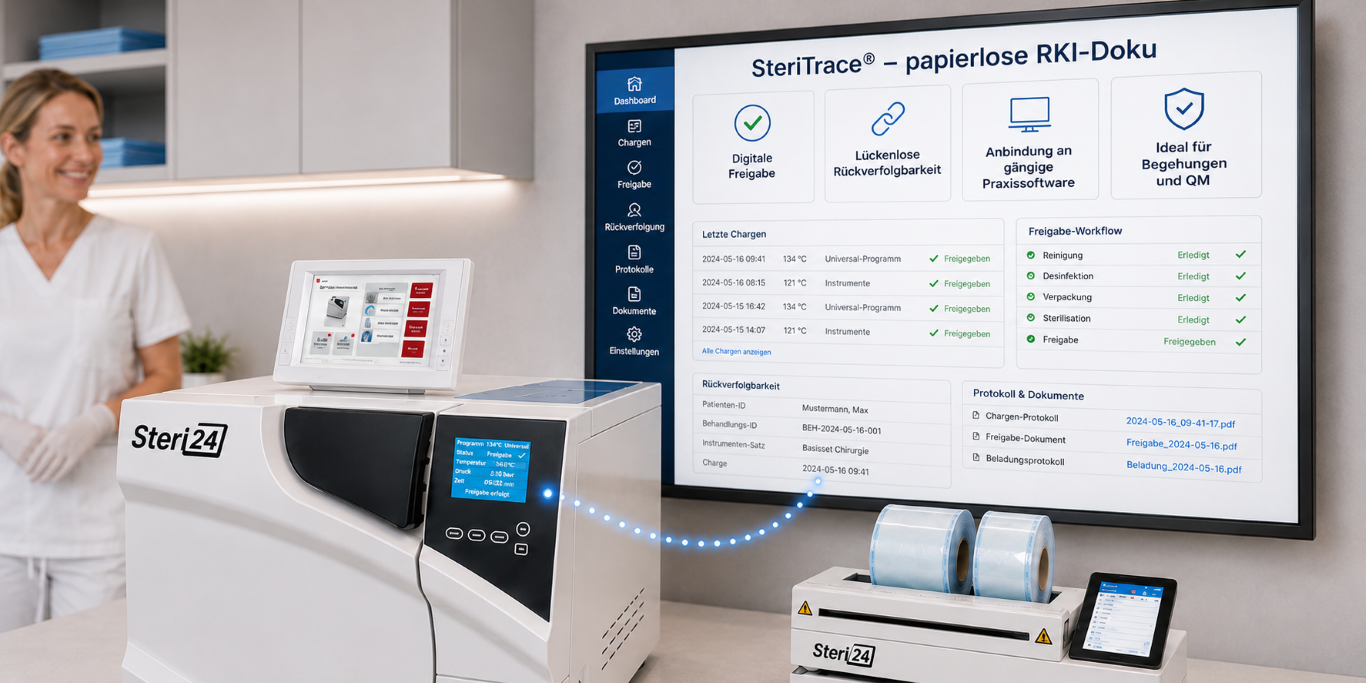
Yes. All devices are Class B to EN 13060 and CE-certified via TÜV SÜD. With SteriTrace you document every batch in an audit-proof, paperless way; on request we carry out validation and maintenance on site.
What is the validation of an autoclave?
Validation is the documented proof that your sterilization process is reproducibly effective under practice conditions. It comprises the initial validation after commissioning and recurring revalidations.
Is validation mandatory?
A validated process is required for the reprocessing of medical devices. The initial validation takes place after commissioning, followed by revalidation at regular intervals. On request we carry out the initial validation and maintenance on site.
When must the initial validation be carried out after purchase?
The initial validation takes place as part of the device commissioning. On request we handle delivery, installation and initial validation on site in accordance with the applicable requirements. We are happy to clarify the details in a consultation.
Can I carry out the validation myself?
Validation requires special measuring technology and expertise and is carried out by trained service personnel. We carry out the initial and revalidation of the device you purchased from us on site.
How often must the autoclave be validated?
Revalidation takes place at regular intervals, usually annually, as well as after significant interventions on the device. We agree the exact cycle as part of your maintenance and validation contract.
Do you handle setup, installation and validation on site?
Yes. On request we handle delivery, installation, commissioning and initial validation directly at your practice. This way your device is ready for use and compliantly documented with no effort on your part.
How is service organized if something fails?
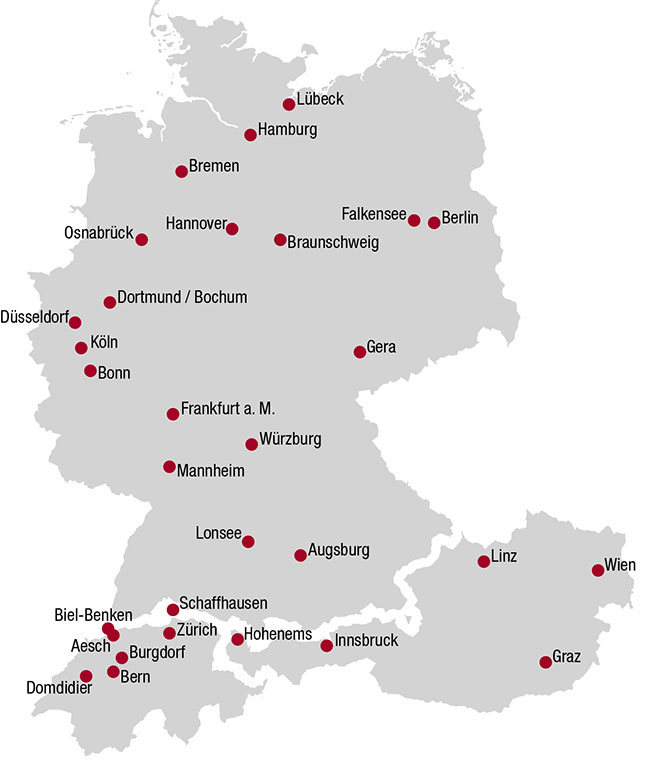
We sell direct from the manufacturer and handle service ourselves, with a dense on-site network of numerous locations and partners across DACH as well as a 24-hour emergency service. Through the Service World you can find your nearest contact.
Are there service partners in my region?
Our service network comprises numerous locations and partners throughout the DACH region. You can see which location is responsible for you in the Service World, or find out in a short consultation.
Do you offer a 24-hour emergency service?
Yes, we offer an emergency service, including at weekends, so that your reprocessing does not stand still unnecessarily in everyday practice. We are happy to clarify availability and terms individually.
What does a service contract include?
A service contract bundles regular maintenance and revalidation of your device and safeguards availability. With a service contract, an extended warranty is also possible. We tailor the specific scope to your practice.
At what interval must the autoclave be serviced?
Maintenance takes place at regular intervals, usually annually, depending on usage and device recommendation. We determine the right cycle together in the service contract.
Is maintenance also required with low usage?
Yes, regular maintenance serves safety and functionality and is also intended for a low number of cycles. It is a prerequisite for reproducibly effective reprocessing.
Is there a loan or replacement device during maintenance or in case of a defect?
A replacement solution can be arranged depending on the situation, so that your reprocessing continues in everyday practice. We are happy to clarify the options individually, ideally as part of a service contract.
What warranty is there on the devices?
A 2-year warranty applies as standard, which can be extended to up to 3 years by concluding a service contract. You will find the exact conditions in the respective warranty documents.
What distinguishes the Premium and Pro model ranges?
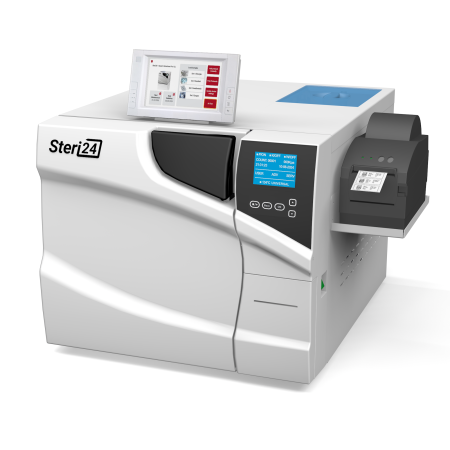
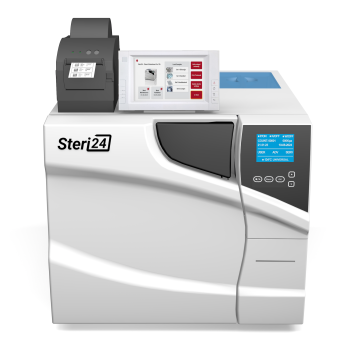
Premium is aimed at the fully digital, connected practice with digital batch release on the touchscreen, LAN/WLAN and connection to practice software, as well as SteriTrace for paperless documentation. Pro is robust, simple and great value, with documentation via USB and thermal printer. Both are Class B and RKI-compliant.
Which model do you recommend for a fully digital orthodontic practice?
For a connected, paperless practice we recommend the Premium range in 12 or 18 litres, with digital batch release on the touchscreen and connection to common practice software. You can determine the optimal configuration using the configurator.
Can I connect the sterilization documentation to my practice software?
Yes, the Premium devices offer LAN/WLAN and a connection to common practice software, so that batches are transferred automatically. The Pro range documents via USB and thermal printer. We will clarify which solution suits your software in a consultation.
What is SteriTrace?
SteriTrace is our assistant for paperless, RKI-compliant batch documentation. With it you document every batch in an audit-proof manner, release it digitally and ensure seamless traceability, ideal for inspections and your quality management.
How does batch release work?
Depending on the model, batch release can be carried out paperlessly on the touchscreen or via your practice software (Premium), or documented classically via a template (Pro). In both cases, a traceable release is created for each batch.
Does the autoclave create the sterilization records itself?
Yes, the device logs every batch with the process parameters. Depending on the model, output is via USB/SD, thermal printer or automatic transfer to your practice PC, and optionally also paperlessly via SteriTrace.
How long must the sterilization and release records be retained?
Reprocessing, release and sterilization records must be retained in an audit-proof manner for several years. With paperless documentation via SteriTrace, these are always retrievable and ready for inspections.
Is a Helix test mandatory in orthodontics?
For the reprocessing of packaged or critical-B instruments, as is common in orthodontics, the Helix test serves as proof of steam penetration and is carried out routinely. For unpackaged semi-critical instruments, a Class 5 indicator is additionally used.
Which sterilization controls are there for the autoclave?
The most relevant are the Helix-test steam indicator for packaged or critical-B instruments and the Class 5 steam indicator for unpackaged or critical-A instruments. In addition there are indicator tape and spore tests; the Bowie-Dick test is only needed for textiles.
How and how often is the vacuum test carried out?
The vacuum test checks the tightness of the chamber and is usually carried out on every working day, or before the first cycle. The device has its own test programme for this purpose.
How can I tell from the record that sterilization was successful?
A successful cycle is shown as passed on the printout or in the digital record, with the achieved values for temperature, pressure and holding time. In the event of a fault, a corresponding error or abort message appears instead of a release.
At what temperature are the instruments sterilized?
Depending on the programme, steam sterilization typically takes place at 134 °C for most instruments or 121 °C for more heat-sensitive goods, with the respective intended holding time. You select the appropriate programme on the device based on the instrument type.
Which programme do I select for packaged instruments?
For packaged instruments you select the Class B programme for packaged sterile goods with a drying phase. The programmes distinguish between solid, porous and hollow-body goods, so that steam reaches all areas.
Must I clean and disinfect instruments before sterilizing?
Yes, sterilization is always preceded by thorough cleaning and disinfection, preferably by machine in a washer-disinfector. Only clean sterile goods can be reliably sterilized.
Do I also need a washer-disinfector?
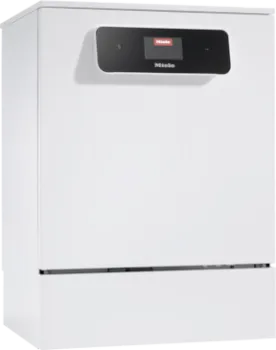
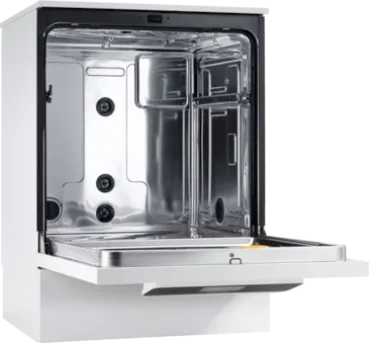
A washer-disinfector handles the machine-based, reproducible cleaning and disinfection before sterilization and is especially recommended for machine reprocessing. We offer autoclave, washer-disinfector and accessories perfectly matched from a single source.
How long do sealed instruments remain sterile?
When correctly sealed and properly stored, packaged sterile goods remain sterile for a longer period; the exact storage period depends on the packaging type and storage conditions. Label the batch and date to keep track of the period.
When do I label the sterilization pouches with the batch number?
Packaging is labelled on the film side or as specified before sterilization, and the batch number is assigned to the completed cycle. With paperless documentation via SteriTrace, the assignment is made digitally.
Are the sterilization pouches compliant with standards?
Our sterilization pouches are manufactured in accordance with the applicable standards for sterilization packaging. Suitable pouches, rolls and the matching CertoSeal sealing device are also available from us.
Do I need a sealing device, and do you offer one?
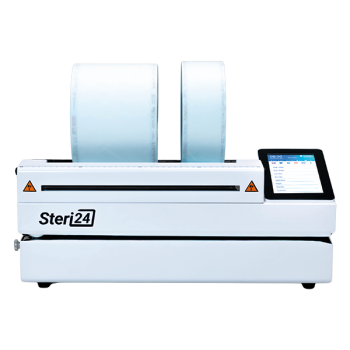
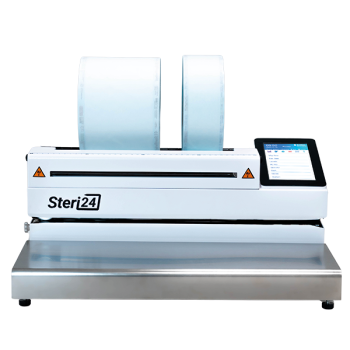
For the standard-compliant packaging of critical instruments you need a sealing device. With CertoSeal we offer validatable sealing devices that integrate seamlessly into your reprocessing.
How much water does the autoclave use per cycle, and what water quality is required?
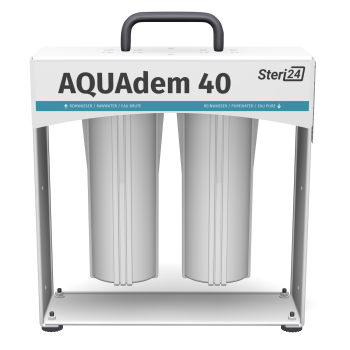
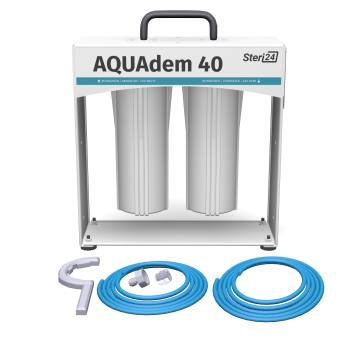
The autoclave requires treated, demineralized water of suitable quality for gentle sterilization and durable technology. With the AQUAdem water treatment, manual filling with distilled water is no longer necessary. You will find the exact consumption in the device data.
Is automatic water treatment worthwhile for the practice?
Automatic water treatment such as AQUAdem continuously supplies the autoclave with water of suitable quality and saves manual refilling with distilled water. This reduces effort and protects the device from deposits.
What does the error message 'feed water empty' mean?
This message appears when the fresh-water tank needs to be refilled; top up with demineralized water or check the connection of the water treatment. If the display remains faulty, our service team will assist you.
My autoclave shows an error or no longer switches on, what should I do?
First check the power connection, fuse and water level. If the error persists or an error code appears, note the message and contact our service team, who will assist you by phone or on site.
The sterile goods are still damp after the programme, why is that?
Residual moisture is usually caused by overloading, incorrect loading or a drying phase that is too short. Reduce the load, arrange pouches on edge and use the appropriate programme with drying; if the problem persists, our service team will help.
I don't know Steri24, why should I switch?
Steri24 sells direct from the manufacturer, without the detour via depots or middlemen, and handles service itself. This gives you a dense on-site service network like that of established expensive suppliers, but at fairer prices. The manufacturer has been building the autoclave since 1957.
What happens to my old autoclave when I switch?
We advise you on the switch, take back your old device regardless of manufacturer and dispose of it properly. This makes the changeover smooth.
Do you offer staff training?
Yes, as part of the commissioning we train your team in operating the device, so that reprocessing works safely from the start. On request, the training can be combined with the initial validation.
What size do I need with a high patient volume in orthodontics?
With higher volume, 18 litres or larger is recommended, in order to reprocess more instruments per batch and avoid waiting times. You can quickly determine the ideal capacity based on your needs using the configurator.